
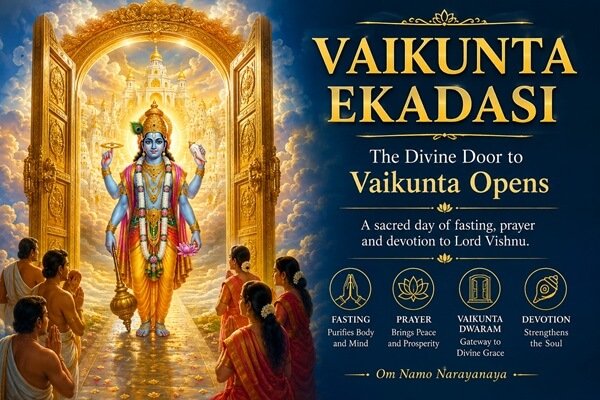
| Vaikunta Ekadasi, also called Mukkoti Ekadasi or Mokshada Ekadashi, falls on Sunday, December 20, 2026. The Ekadashi Tithi begins at 10:09 PM on December 19 and ends at 8:14 PM on December 20. Devotees who fast should break their Parana the next morning, December 21, generally between about 6:12 AM and 8:21 AM local time, though exact Parana windows shift slightly by location, so it’s worth checking your local panchang. This year’s observance also coincides with Gita Jayanti, the day the Bhagavad Gita is believed to have been revealed. |
Once a year, in the quiet stretch between December and January, temples dedicated to Lord Vishnu fill before sunrise. Devotees line up for hours, some having traveled through the night, all waiting for a single symbolic gate, the Vaikuntha Dwaram, to open. For anyone raised in a Vaishnava household, Vaikunta Ekadasi needs no introduction. For everyone else searching for the date, the timings, and what actually happens on this day, here’s everything worth knowing before December 20, 2026, laid out clearly enough that you can plan your fast, your temple visit, or simply your understanding of the day without digging through a dozen conflicting sources.
When Is Vaikunta Ekadasi 2026?
Vaikunta Ekadasi falls on Sunday, December 20, 2026. It’s observed during the Shukla Paksha, the waxing phase of the moon, in the Hindu month of Margashirsha or Dhanurmasa depending on the regional calendar you follow. Because it falls on the same date as Mokshada Ekadashi, this year’s observance also lines up with Gita Jayanti, the anniversary of the day Lord Krishna is believed to have revealed the Bhagavad Gita to Arjuna on the battlefield of Kurukshetra, giving the day an extra layer of spiritual significance for many devotees.
Exact Timings for 2026
| Event | Date and Time |
| Ekadashi Tithi Begins | 10:09 PM, December 19, 2026 |
| Ekadashi Tithi Ends | 8:14 PM, December 20, 2026 |
| Main Observance Day | Sunday, December 20, 2026 |
| Parana (Fast-Breaking) Window | Approx. 6:12 AM to 8:21 AM, December 21, 2026 |
| Dwadashi Tithi Ends | 5:36 PM, December 21, 2026 |
A quick but important note on the Parana window: this timing shifts slightly depending on your city and local sunrise, since the fast must be broken after sunrise and within Dwadashi Tithi. The figures above are commonly cited approximations for North Indian cities; if precision matters to you, particularly if you’re observing a strict Vrat, look up the exact sunrise-based Parana time for your specific location using a panchang site or app rather than relying on a single national timing.
What Vaikunta Ekadasi Actually Means
The word Vaikuntha refers to Lord Vishnu’s celestial abode, the spiritual realm beyond the material universe where, according to tradition, the soul finds eternal liberation. Ekadashi simply means the eleventh day, referring to the eleventh day of each lunar fortnight, which occurs twice a month, once during the waxing moon and once during the waning moon. Among the roughly twenty-four Ekadashis observed across a typical year, the one that falls in the month of Dhanurmasa carries special weight and is glorified specifically as Vaikuntha Ekadasi.
The day is also widely known as Mukkoti Ekadasi, a name derived from the Sanskrit and Telugu word Mukkoti, meaning three crore, or thirty million. Tradition holds that on this day, thirty million celestial beings, gods, sages, and divine attendants, assemble in Vaikuntha to witness Lord Vishnu, and that the doorway connecting the mortal and divine realms, the Vaikuntha Dwaram, opens specifically for devotees to pass through symbolically at their local temple. In Kerala, where the Malayalam calendar is followed, the same observance is known as Swarga Vathil Ekadashi, or the Ekadashi of Heaven’s Door.
The Story Behind the Day
Vaikunta Ekadasi’s origins trace back to the Padma Purana, one of Hinduism’s major devotional texts. According to the story, a powerful demon named Muran had been tormenting the Devas, the celestial beings, for a prolonged period.
Unable to withstand his atrocities any longer, the Devas approached Lord Vishnu for protection. Vishnu engaged Muran in battle, but realized the demon could only be defeated through a specific divine female energy rather than conventional weapons. From this struggle emerged a goddess, sometimes identified as Ekadashi Devi herself, who ultimately vanquished the demon and restored peace to the heavens.
Pleased by her victory, Vishnu is said to have granted her a boon: that anyone who observed a sincere fast on this day, the eleventh day of the lunar fortnight in the month of Margashirsha, would be freed from their accumulated sins and granted passage to Vaikuntha itself. That boon is the foundation of the fasting tradition still observed by millions of devotees today.
The day is also associated with the Samudra Manthan, the churning of the cosmic ocean of milk, during which Amrit, the nectar of immortality, is said to have emerged and been distributed among the demigods, another layer of the day’s association with liberation, purification, and divine grace.
Why This Day Is Considered So Significant
Among all the Ekadashis observed throughout the year, Vaikunta Ekadasi holds a uniquely elevated status for several overlapping reasons. Scriptural tradition holds that anyone who dies on this specific day is freed from the cycle of birth and death, moksha, and passes directly into Vaikuntha rather than continuing through further reincarnation. Even short of that, sincere observance of the fast and rituals on this day is believed to carry merit equivalent to observing many ordinary Ekadashis combined.
It’s also, practically speaking, one of the biggest single-day temple events of the year across South India. Temples such as Tirumala Tirupati, Srirangam, and countless other Vishnu temples across Andhra Pradesh, Telangana, Tamil Nadu, and Karnataka see some of their largest annual crowds specifically for the Vaikuntha Dwara Darshanam, the symbolic passage through the northern gate representing the gateway to Vaikuntha itself.
How Devotees Observe the Day
Observance generally spans a full day and night, sometimes extending into a two-day period depending on family tradition, and centers on fasting, prayer, and temple worship.
The Fast
Fasting typically begins the day before Ekadashi with a single, light meal, and intensifies into a stricter fast on Ekadashi itself. Some devotees observe a complete Nirjala-style fast, avoiding both food and water entirely, while others follow a more moderate approach centered on fruits and milk. Rice and grains are traditionally avoided altogether, partly because rice is associated in folklore with the demon Muran, and partly because grains are broadly avoided across most Ekadashi observances in Hindu tradition. Legumes, non-vegetarian food, and alcohol are also avoided by those observing the fast.
The Night Vigil
Many devotees stay awake through the night preceding or following the main fasting day, a practice known as Jagarana, spending the hours in devotional chanting rather than sleep. Common practices during this vigil include reciting the Vishnu Sahasranama, the thousand names of Vishnu, chanting the Vishnu Ashtottara Shatanamavali, and reading from the Bhagavad Gita, particularly given this year’s overlap with Gita Jayanti.
Temple Visits and Vaikuntha Dwara Darshanam
For many devotees, the heart of the day is a temple visit, specifically to pass through the Vaikuntha Dwaram, a special northern gateway opened only on this occasion at many Vishnu temples. Passing through this gate is treated as deeply symbolic, a representation of the soul’s passage into the divine presence. Because of the scale of these gatherings, especially at major temples, many devotees arrive well before dawn, and some temples now offer online booking for special darshan slots to help manage the crowds.
Breaking the Fast: Parana
The fast is broken the following morning during the Parana window, and timing here genuinely matters in traditional practice. Parana should take place after sunrise, within Dwadashi Tithi, and ideally during Pratahkal, the early morning hours, rather than around midday. Tradition also advises against breaking the fast during Hari Vasara, the first quarter of the Dwadashi period, considered an inauspicious window for ending the Vrat. If you’re following the fast strictly, checking the specific Parana time for your city rather than relying on a generic national timing is the safer approach.
Also read: Vaitheeswaran Koil Temple 2026: Timings, Pooja, Nadi Jothidam & Online Booking
What to Eat and Avoid
| Category | Guidance |
| Generally Avoided | Rice and grains, legumes and lentils, non-vegetarian food, alcohol, onion and garlic in most traditions |
| Commonly Permitted (for partial fasts) | Fruits, milk and dairy, nuts, sabudana (tapioca pearls), rock salt, sweet potato, water chestnut flour |
| Prasadam Offerings | Foods made from milk, saffron, and fruit are commonly prepared as offerings and shared after worship |
Regional Names and Variations
- Mukkoti Ekadasi — the name most widely used in Andhra Pradesh, Telangana, and Karnataka, referring to the thirty million celestial beings said to gather on this day.
- Vaikuntha Ekadashi — the most common pan-Indian name, referencing Vishnu’s celestial abode directly.
- Swarga Vathil Ekadashi — the name used in Kerala under the Malayalam calendar, meaning the Ekadashi of Heaven’s Door.
- Mokshada Ekadashi — the name used in North India under the Purnimanta lunar calendar system, where the same tithi is associated specifically with granting moksha.
These aren’t different festivals, they’re regional names for the same lunar observance, which is why you’ll sometimes see slightly different framing depending on which part of India, or which calendar tradition, a source is drawing from.
A Simple Step-by-Step Guide for First-Time Observers
- The day before Ekadashi: eat a single, light satvik meal in the evening, avoiding heavy or oily food.
- On Ekadashi morning: wake before sunrise, bathe, and begin your fast, whether that’s a complete fast or a fruits-and-milk approach.
- Through the day: visit a Vishnu temple if possible, participate in Vaikuntha Dwara Darshanam where available, and spend time in prayer or reading scripture.
- Through the night: many devotees observe Jagarana, staying awake to chant the Vishnu Sahasranama or read the Bhagavad Gita.
- The following morning (Dwadashi): break your fast during the Parana window for your location, ideally in the early morning hours after sunrise.
- Avoid breaking the fast during Hari Vasara or at midday; if you can’t manage the morning Parana window, the next best option is after midday rather than during it.
Common Mistakes to Avoid
- Breaking the fast before sunrise or before Dwadashi Tithi has actually begun, which is considered an invalid Parana.
- Relying on a single generic Parana time found online instead of checking the specific window for your city, since sunrise-based timings shift by location.
- Eating rice or grains inadvertently in prepared or packaged food, which is easy to overlook if you’re new to the fasting rules.
- Breaking the fast during Hari Vasara, the first quarter of Dwadashi, which tradition specifically advises against.
- Assuming a strict Nirjala fast is mandatory. Tradition allows for fruits-and-milk or other moderate approaches, and health considerations, pregnancy, illness, or medical conditions, should always take priority over an especially strict observance.
Is It Safe to Fast? A Practical Note
Fasting traditions exist across many faiths, and Ekadashi observance is generally safe for healthy adults when approached sensibly, staying hydrated if you’re not doing a fully waterless fast, and easing back into normal eating gradually during Parana rather than overeating immediately. That said, people managing diabetes, pregnancy, chronic illness, or any condition where fasting could pose a real health risk should speak with a doctor before observing a strict fast, and should feel no spiritual obligation to choose an extreme approach over a modified one that keeps them safe.
Why Two Different Dates Sometimes Appear Online
If you search around and notice a source citing a slightly different date for Vaikunta Ekadasi 2026, that’s usually not an error, it reflects a real regional difference in how Ekadashi is calculated. Two major lunar calendar systems are used across India: the Amanta system, common in South India, and the Purnimanta system, common in North India. Because the tithi can begin or end at different points relative to a given day’s sunrise, and because some families follow the Smartha tradition of observing the fast a day apart from the Vaishnava tradition, you may occasionally see sources list observance a day earlier or later than the primary date given here. When in doubt, the safest approach is to follow the date and timing recommended by your own family tradition or local temple rather than defaulting to whichever date appears first in a search result.
What Makes This Ekadashi Different From the Other Twenty-Three
With roughly twenty-four Ekadashis occurring across a typical Hindu calendar year, it’s fair to ask why this particular one gets singled out for such elaborate temple celebrations and crowds that dwarf most other fasting days. Part of the answer is scriptural: the specific boon associated with this day, tied directly to liberation from the cycle of rebirth, gives it a spiritual weight that other Ekadashis, while still meaningful, don’t carry in quite the same way.
Part of the answer is also cultural and historical, particularly in South India, where the Vaikuntha Dwara Darshanam tradition at major temples like Tirumala Tirupati and Srirangam has grown into one of the single largest annual pilgrimage events in the region, drawing devotees who may not observe every Ekadashi throughout the year but make a point of attending this one specifically.
That combination, deep scriptural significance plus a genuinely spectacular, once-a-year temple tradition, is part of why Vaikunta Ekadasi tends to draw participation even from people who describe themselves as only moderately religious the rest of the year. It occupies a similar cultural space to how major holidays function across other faiths: a day when observance extends well beyond the most devout regular practitioners.
Frequently Asked Questions
When is Vaikunta Ekadasi in 2026? Sunday, December 20, 2026. The Ekadashi Tithi begins at 10:09 PM on December 19 and ends at 8:14 PM on December 20.
What time should I break my fast? The Parana window generally falls between approximately 6:12 AM and 8:21 AM on December 21, 2026, though exact timing varies by city based on local sunrise. Check your local panchang for precision.
What is the difference between Vaikuntha Ekadasi and Mukkoti Ekadasi? Nothing, they’re the same observance. Mukkoti Ekadasi is simply the name most commonly used in Andhra Pradesh, Telangana, and Karnataka.
Can I eat rice on Vaikunta Ekadasi? Traditionally, no. Rice and other grains are avoided on this day, in part because of the day’s association with the demon Muran in the Padma Purana story.
Do I have to do a complete waterless fast? No. While some devotees observe a strict Nirjala fast, many others follow a more moderate approach centered on fruits and milk. Health should always take priority over strictness.
What is the Vaikuntha Dwaram? A special gateway, often on the northern side of a temple, opened specifically on this day at many Vishnu temples. Passing through it is treated as symbolic of the soul’s passage into Vishnu’s divine presence.
Why does 2026’s Vaikunta Ekadasi also mention Gita Jayanti? Because Mokshada Ekadashi, the North Indian name for this same tithi, coincides with Gita Jayanti, the day Lord Krishna is believed to have revealed the Bhagavad Gita to Arjuna.
What should I do if I miss the correct Parana window? Tradition advises breaking the fast as soon as reasonably possible after the ideal window, avoiding midday if you can, rather than skipping Parana entirely.
Is Vaikunta Ekadasi observed the same day across India? The main tithi is the same nationally, but because Ekadashi can begin or end at different points relative to sunrise in different regions, some families observe the fast a day earlier or later based on local tradition and calendar system.
Can I book temple darshan in advance for this day? Many major temples now offer online booking for special Vaikuntha Ekadasi darshan slots, which is worth arranging in advance given how large crowds typically are on this day.