
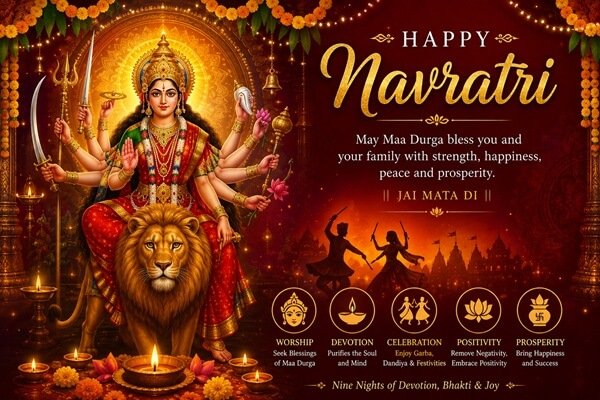
The Navratri most people mean when they search this, Sharad Navratri, begins Sunday, October 11, 2026, with Ghatasthapana, and concludes with Vijayadashami (Dussehra) on Tuesday, October 20, 2026. The Ghatasthapana muhurat falls between roughly 6:19 AM and 10:12 AM on October 11. Chaitra Navratri, the spring observance, already took place from March 19 to March 27, 2026. Two additional Gupt Navratris, Magha and Ashadha, are observed mainly by tantric practitioners and fell in January and July 2026 respectively.
If you’ve searched “Navratri 2026″ hoping for a simple date, here’s the short version: most people mean Sharad Navratri, the big one, the nine nights of Garba, Dandiya, Durga Puja pandals, and fasting that light up the autumn calendar across India and the diaspora. It runs October 11 to October 20, 2026. But Navratri isn’t actually a single festival, it’s four of them spread across the year, and knowing the difference matters if you’ve seen conflicting dates online while planning a trip home, a family puja, or your Garba outfit. Here’s the complete picture.
| Navratri 2026 | Dates | Who Observes It |
|---|---|---|
| Magha Gupt Navratri | January 19 – January 27 | Tantric practitioners, esoteric sadhana |
| Chaitra Navratri | March 19 – March 27 | Widely celebrated, especially North India; ends on Ram Navami |
| Ashadha Gupt Navratri | July 15 – July 23 | Tantric practitioners, Varahi and Navadurga sadhana |
| Sharad (Shardiya) Navratri | October 11 – October 20 | The most widely celebrated; ends in Dussehra |
When people say “Navratri” without specifying which one, they almost always mean Sharad Navratri. It’s the one associated with Garba nights, Durga Puja pandals in Bengal, Golu displays in the South, and the giant Ramlila performances that culminate in Dussehra. The rest of this guide focuses primarily on Sharad Navratri, with a dedicated section further down for Chaitra Navratri specifically.
| Event | Date and Time |
|---|---|
| Pratipada Tithi Begins | 9:19 PM, October 10, 2026 |
| Pratipada Tithi Ends | 9:30 PM, October 11, 2026 |
| Ghatasthapana Day | Sunday, October 11, 2026 |
| Ghatasthapana Muhurat | 6:19 AM – 10:12 AM |
| Abhijit Muhurat (alternative) | 11:44 AM – 12:31 PM |
| Durga Ashtami / Maha Navami | October 18–19 (varies by panchang, see note below) |
| Vijayadashami (Dussehra) | Tuesday, October 20, 2026 |
A genuinely important note for 2026: this year’s Navratri runs ten days instead of the usual nine because of how the tithis align. Some panchangs, including Drik Panchang, list Durga Ashtami and Maha Navami together on October 19, with Sandhi Puja observed between 10:27 and 11:15 AM. Other panchangs, including Prokerala, split them differently, observing Durga Ashtami with Maa Mahagauri on October 18 and Navami with Maa Siddhidatri on October 19. If you’re planning Kanya Puja or a Sandhi Puja specifically, follow whichever panchang your family or local temple community already uses rather than assuming one version is universally correct.
Navratri, from the Sanskrit Nava, meaning nine, and Ratri, meaning nights, honors the Goddess Durga across nine nights and ten days. According to the Devi Mahatmya, also known as the Durga Saptashati, one of Hinduism’s central texts on the divine feminine, the festival commemorates Durga’s battle against the shape-shifting demon Mahishasura, a fight that stretched across nine days before she finally defeated him on the tenth, a day now celebrated as Vijayadashami, or Dussehra.
Each demon in Durga’s mythology is generally understood to represent a specific vice, ego, greed, anger, and so on, so the story is read less as ancient history and more as a symbolic victory of good over the darker instincts every person carries.
Across the nine nights, Durga is worshipped in nine distinct forms, collectively called the Navadurga, each associated with a different day, color, and quality. Sharad Navratri in particular is followed by Dussehra, and in North India, by Dussehra’s own connection to the Ramayana, the day Lord Rama is believed to have defeated the demon king Ravana, giving the same ten-day window a second, overlapping mythological significance in much of the country.
The Nine Forms of Durga, Day by Day
| Day | Goddess | Association |
|---|---|---|
| Day 1 | Shailputri | Daughter of the mountains; represents strength and new beginnings |
| Day 2 | Brahmacharini | The ascetic form; represents penance and devotion |
| Day 3 | Chandraghanta | The warrior form; represents courage and grace |
| Day 4 | Kushmanda | Believed to have created the universe with her smile; represents creative energy |
| Day 5 | Skandamata | Mother of Skanda (Kartikeya); represents maternal love |
| Day 6 | Katyayani | The fierce warrior form; represents righteous anger |
| Day 7 | Kalaratri | The fiercest form; represents destruction of ignorance and fear |
| Day 8 | Mahagauri | The serene, purified form; represents peace and forgiveness |
| Day 9 | Siddhidatri | The bestower of spiritual powers; represents fulfillment and perfection |
One of the most striking things about Navratri is how differently it’s expressed from state to state, even though the underlying devotion is the same.
In Gujarat, the festival is inseparable from Garba and Dandiya Raas, community dances performed nightly around a central shrine or Garba pot, drawing enormous crowds to organized events that run late into the night for all nine days.
In West Bengal, the same nine days center on elaborately constructed Durga Puja pandals, temporary structures housing artistic idols of the goddess, with the final days, particularly Ashtami and the immersion on Dashami, drawing some of the largest public gatherings in the country.
In South India, especially Tamil Nadu, Karnataka, and Andhra Pradesh, households traditionally set up Golu, tiered displays of dolls and figurines depicting deities, everyday scenes, and mythological stories, which neighbors and family visit throughout the nine nights.
In North India, Navratri fasting is widespread, often paired with evening Ramlila performances reenacting the story of Rama, building toward the burning of Ravana effigies on Dussehra itself.
Jammu’s Vaishno Devi Temple, one of the most visited Hindu pilgrimage sites in the country, sees a massive surge in footfall specifically during Navratri, with devotees undertaking the trek to the shrine as part of their observance.
Fasting and Puja Rules
Fasting during Navratri follows broadly similar principles to other major Hindu fasting observances, though the specifics vary by family and region.
Devotees commonly avoid grains, lentils, onion, and garlic for the full nine days, relying instead on fruits, milk, dairy, and specific fasting-friendly staples like sabudana, water chestnut flour, and rock salt.
Some observe a complete fast on select days, particularly the first and last, while eating one satvik meal on the remaining days. Others fast the entire nine days, breaking only on Navami or after Kanya Puja.
Ghatasthapana: Starting the Observance
The festival formally begins with Ghatasthapana, sometimes called Kalash Sthapana, a ritual installation of a sacred pot symbolizing the goddess’s presence for the following nine days.
Timing matters here: Ghatasthapana should be performed during the Pratipada tithi, ideally within the specific muhurat window for the day, and should never be performed in the evening or at night.
If the primary morning muhurat is missed, the Abhijit Muhurat, a separately auspicious midday window, is the accepted fallback, but Ghatasthapana is not performed after midday under any circumstance.
Kanya Puja
On Ashtami or Navami, depending on family tradition, many households perform Kanya Puja, a ritual honoring young girls as living representations of the goddess.
The girls are typically welcomed with foot-washing, offered a meal, given small gifts, and treated with the same reverence one might show a deity, a practice widely considered one of the most meaningful parts of the entire festival for families who observe it.
Sandhi Puja
For those observing Durga Puja in the Bengali tradition specifically, Sandhi Puja marks the precise transitional moment between Ashtami and Navami, considered an especially powerful 48-minute window.
In 2026, that window falls between approximately 10:27 and 11:15 AM on October 19 according to Drik Panchang’s calculation, though as noted earlier, some regional panchangs calculate the Ashtami-Navami boundary slightly differently.
Chaitra Navratri, the spring counterpart to Sharad Navratri, took place from Thursday, March 19 to Friday, March 27, 2026.
It carries its own significant weight, since Chaitra Navratri’s first day also marks the start of the Hindu New Year, Vikram Samvat, making 2026’s observance the beginning of Vikram Samvat 2083.
The festival concluded on Ram Navami, the celebration of Lord Rama’s birth, and in a notably rare calendar alignment, Ram Navami coincided directly with Durga Ashtami this year, on March 26, giving the final days of the spring festival unusually concentrated significance.
Chaitra Navratri is also known as Vasanta Navratri or Rama Navratri, and is especially prominent in North India, though families across the country observe it with the same fasting and puja structure as the autumn festival.
Kashmiri Pandits mark the first day of Chaitra Navratri as Navreh, their New Year, preparing a special thali the night before containing rice, curd, flowers, bread, a pen, a mirror, walnuts, and a copy of the Panchang, viewed first thing the following morning as an auspicious start to the year.
Beyond the two widely known Navratris, Hindu tradition recognizes two additional, lesser-known observances known as Gupt Navratri, meaning secret or hidden Navratri.
Magha Gupt Navratri fell from January 19 to January 27, 2026, and Ashadha Gupt Navratri from July 15 to July 23, 2026.
Both are observed primarily by tantric practitioners and serious spiritual seekers rather than the general public, centered on esoteric sadhana, worship of the Dasha Mahavidyas, and deep meditative practice rather than the public celebrations associated with Chaitra and Sharad Navratri.
If your search for “Navratri 2026” turned up one of these dates unexpectedly, that’s likely why, they’re real, but they’re a different kind of observance than most people are picturing.
A Simple Day-by-Day Guide for First-Time Observers
- Day 1 (Pratipada): Perform Ghatasthapana during the correct morning muhurat; begin your fast if you’re observing one.
- Days 2 through 6: Continue daily puja, lighting a lamp (Akhand Jyot) if your family tradition includes it, and observe your chosen fasting approach.
- Day 7 (Saptami) and Day 8 (Ashtami): Many families intensify prayer and observance; Sandhi Puja is performed by those following Bengali Durga Puja tradition.
- Day 8 or 9: Perform Kanya Puja, honoring young girls as forms of the goddess.
- Day 9 (Navami): Conclude the main worship with Navami Homa; break any strict fast according to your family’s Parana timing.
- Day 10 (Vijayadashami/Dussehra): Celebrate the goddess’s, and in North India, Lord Rama’s, victory over evil, often marked by Ravana effigy burnings and idol immersions.
Common Mistakes to Avoid
- Performing Ghatasthapana in the evening or after midday, both of which are considered inappropriate timing regardless of convenience.
- Assuming all four Navratris follow the same public celebration style; the Gupt Navratris are private, esoteric observances, not smaller versions of Garba season.
- Ignoring the panchang discrepancy around Ashtami and Navami this year; check your specific community’s calculation before planning Kanya Puja or Sandhi Puja.
- Overcommitting to a strict nine-day fast without accounting for personal health; a modified fasting approach is widely accepted and shouldn’t be seen as a lesser observance.
- Booking Garba or Dandiya event tickets late; major venues in cities with large celebrations often sell out well before the festival begins.
If you’ve noticed some sources listing Sharad Navratri as nine days ending October 19 and others extending it to October 20, that’s the same tithi-alignment issue mentioned above playing out in how different publishers choose to present it.
Some calendars report the last day of active worship, Navami, as the effective end of Navratri proper, treating Vijayadashami as a separate, following celebration. Others include Dussehra itself as the tenth and final day of the broader festival window.
Neither approach is wrong, they’re just different conventions for where one festival’s coverage ends and the next begins.
For planning purposes, the practical takeaway is simple: worship and fasting activities run through Navami, and the culminating celebration, Vijayadashami, follows immediately after on October 20.
Outside India, Navratri has become one of the most visible Hindu festivals celebrated by diaspora communities, particularly in the United States, United Kingdom, and Canada, where large Gujarati and Bengali communities organize Garba nights and Durga Puja events that draw attendance well beyond the immediate community.
Major cities with significant South Asian populations often see multiple competing Garba events running simultaneously across a single weekend, complete with professional dandiya instructors, live dhol players, and vendors selling festival attire.
For many second-generation families, these events have become as much a cultural touchpoint and community gathering as a strictly religious observance, a pattern common to how immigrant communities often adapt major festivals to serve both spiritual and cultural continuity purposes simultaneously.
If you’re planning to attend a Garba or Durga Puja event as part of your own Navratri 2026 celebrations, especially in a city with multiple large events, it’s worth booking early. Popular venues and community-hall Garba nights in cities with large diaspora populations have increasingly sold out weeks in advance in recent years, a reflection of just how mainstream the festival’s public celebrations have become well beyond India’s borders.
Frequently Asked Questions
Sharad Navratri, the main autumn observance, runs from October 11 to October 20, 2026. Chaitra Navratri, the spring observance, ran from March 19 to March 27, 2026.
Because of how the Ashtami and Navami tithis align this year, some panchangs list them on separate days rather than the usual overlap, extending the practical observance window by a day.
What is Ghatasthapana and when should it be done?
It’s the ritual installation of a sacred pot marking the start of Navratri, performed during a specific morning muhurat on the first day, never in the evening or after midday.
Chaitra Navratri falls in spring (March-April) and ends on Ram Navami; Sharad Navratri falls in autumn (September-October) and ends on Dussehra. Sharad Navratri is more widely celebrated nationally.
Two additional, lesser-known Navratris, observed in the months of Magha and Ashadha, centered on private, esoteric tantric practice rather than public celebration.
What is Kanya Puja?
A ritual, usually performed on Ashtami or Navami, honoring young girls as living representations of the goddess through foot-washing, a meal, and small gifts.
Do I have to fast for all nine days?
No. Many devotees fast only on the first and last days, or follow a modified fast with fruits and milk throughout. Full nine-day fasting is a personal or family choice, not a requirement.
What is Vijayadashami?
Also called Dussehra, it’s the tenth day marking Durga’s victory over the demon Mahishasura, and in North India, Lord Rama’s victory over Ravana. It falls on October 20, 2026.
No. Gujarat centers on Garba and Dandiya, West Bengal on Durga Puja pandals, South India on Golu doll displays, and North India on Ramlila performances and fasting, all within the same nine-night framework.