
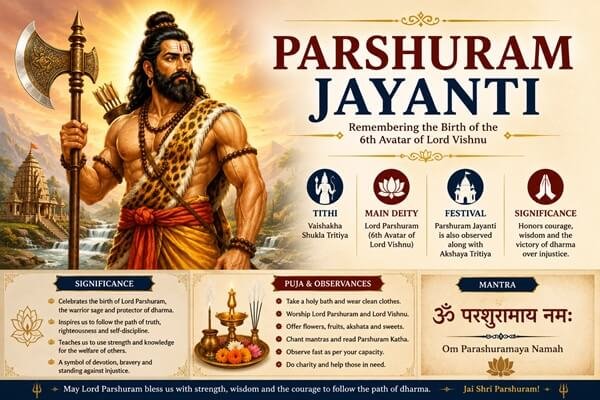
Parshuram Jayanti is celebrated every year to remember the birth of Lord Parshuram, who is traditionally regarded as the sixth incarnation of Lord Vishnu.
Lord Parshuram is different from many other forms of Lord Vishnu. He is shown as a sage carrying an axe and is remembered for his courage, knowledge, discipline and strong stand against injustice.
Parshuram Jayanti falls on Vaishakha Shukla Tritiya, the third day of the bright fortnight of the Vaishakha month. It is also closely connected with Akshaya Tritiya, one of the important days in the Hindu calendar.
In 2026, Parshuram Jayanti was observed on Sunday, April 19, 2026.
The date can be confusing because the Tritiya tithi continued into April 20. The tithi began at 10:49 AM on April 19 and ended at 7:27 AM on April 20. Panchang-based sources that follow the Pradosh rule place Parshuram Jayanti on April 19. A few news articles reported April 20, so devotees may have seen both dates online.
For devotees, Parshuram Jayanti is a day to remember Lord Parshuram, pray to Lord Vishnu, read religious stories, observe a vrat according to one’s family tradition and try to follow the values of truth, courage and dharma.
Parshuram Jayanti 2026 Date and Time
Here are the important details for 2026:
| Event | Date / Time |
|---|---|
| Parshuram Jayanti | Sunday, April 19, 2026 |
| Hindu month | Vaishakha |
| Paksha | Shukla Paksha |
| Tithi | Tritiya |
| Tritiya Tithi Begins | April 19, 2026 at 10:49 AM |
| Tritiya Tithi Ends | April 20, 2026 at 7:27 AM |
| Akshaya Tritiya | Around April 19–20 depending on calendar tradition |
| Main deity | Lord Parshuram |
| Lord Parshuram’s position | Sixth avatar of Lord Vishnu |
The exact puja timing can vary by city because sunrise, sunset and Pradosh timing are location-based. Drik Panchang’s 2026 calculation for Pen, Maharashtra gives Parshuram Jayanti on April 19 and explains that the festival is linked to the Tritiya tithi during Pradosh Kala.
Why Are Some Websites Saying April 20?
This is an important question because many readers may search for the date and find two answers.
The reason is the Tritiya tithi.
In 2026, Tritiya started on April 19 at 10:49 AM and continued until April 20 at 7:27 AM. Different festivals use different rules for deciding the festival day.
Parshuram Jayanti is traditionally connected with the time when the Tritiya tithi is present during Pradosh Kala. According to the Panchang calculation used by Drik Panchang, this gives April 19, 2026 as Parshuram Jayanti.
Times of India also reported April 19 as the Parshuram Jayanti date and gave the same Tritiya timings.
A few other news reports used April 20, which is why the date caused confusion online.
So, for an article about Parshuram Jayanti 2026, the clearest date to give is:
Parshuram Jayanti 2026 – Sunday, April 19, 2026.
Who Is Lord Parshuram?
Lord Parshuram is traditionally regarded as the sixth avatar of Lord Vishnu.
His name is made up of two parts:
- Parashu means axe.
- Rama is his name.
So Parashuram means Rama who carries the axe.
He is also known by names such as:
- Bhargava Rama
- Rama Jamadagnya
- Jamadagnya
- Bhargava
- Veerarama
According to Hindu tradition, Parshuram was born to Sage Jamadagni and Mata Renuka. His father belonged to the Brahmin tradition, while his mother is described in traditional accounts as having a Kshatriya background. This is one reason Parshuram is often described as having both the qualities of a sage and a warrior.
He is usually shown with an axe, which he received from Lord Shiva after performing penance.
Lord Parshuram is remembered not only as a warrior but also as a knowledgeable sage and teacher.
His stories appear in different Hindu texts, including the Ramayana, Mahabharata, Puranas and other religious traditions.
Why Is Lord Parshuram Called a Warrior Sage?
Lord Parshuram is often described as a Brahmin warrior or warrior sage.
He was born in a family of sages and received spiritual knowledge, but he also learned the use of weapons.
His life is often presented through two sides:
Knowledge and discipline
and
Courage and protection of dharma
This combination is one of the main reasons devotees remember him.
Lord Parshuram’s stories are not only about fighting. They also talk about obedience, respect for parents and teachers, penance, self-control and standing against wrongdoing.
The Government of India’s PIB, while greeting people on Parshuram Jayanti in 2026, described him as an inspiration to stand against injustice and remain firm on the path of truth, and highlighted his courage and wisdom.
Parshuram Jayanti Story
There are several stories connected with Lord Parshuram. The story of his birth and early life is especially important on Parshuram Jayanti.
Birth of Lord Parshuram
Lord Parshuram was born to Sage Jamadagni and Renuka Devi.
Jamadagni was a great sage belonging to the Bhrigu tradition.
According to Hindu tradition, Parshuram was born at a time when society was facing serious problems caused by powerful and unjust rulers.
Lord Vishnu took the form of Parshuram to restore dharma and control rulers who had become cruel and misused their power.
This is why Parshuram is often remembered as a protector of dharma.
Traditional accounts describe him as the sixth incarnation of Lord Vishnu and one of the Chiranjivis, or beings believed to live for a very long time.
Parshuram and His Father Jamadagni
Sage Jamadagni was a respected sage.
Parshuram was very devoted to his father and followed his instructions.
One of the famous stories tells about an extremely difficult command given by Jamadagni to his sons involving their mother Renuka.
The story is found in Hindu religious traditions and is understood differently by different people.
According to the traditional account, Jamadagni asked his sons to carry out a severe command. The other sons refused, but Parshuram obeyed.
Jamadagni was pleased with Parshuram’s obedience and offered him a boon.
Parshuram asked that his mother and brothers be brought back to life and that they should not remember what had happened.
Jamadagni granted his request. This story is often used to show Parshuram’s obedience to his father and the power of a father’s blessing.
Parshuram Receives the Axe From Lord Shiva
Another important part of Parshuram’s story is his devotion to Lord Shiva.
Parshuram performed severe penance to please Shiva.
Lord Shiva was pleased with his devotion and gave him divine weapons, including the famous Parashu, or axe.
This axe became closely associated with Parshuram.
That is why pictures and statues of Lord Parshuram usually show him holding an axe.
The Tirumala Tirupati Devasthanams’ publication also describes Parshuram’s penance to Lord Shiva and his receiving divine weapons from Shiva.
Parshuram and Kartavirya Arjuna
One of the most important stories in the life of Parshuram is his conflict with King Kartavirya Arjuna.
Kartavirya Arjuna was a powerful king.
According to traditional stories, he had great strength and became proud of his power.
Sage Jamadagni had a divine cow associated with the ability to provide what was needed for guests and rituals.
Kartavirya Arjuna came to the sage’s ashram and wanted the cow.
Jamadagni refused to give her.
The situation became violent in different versions of the story.
Parshuram eventually fought Kartavirya Arjuna and killed him.
This became one of the main events in the later story of Parshuram.
Why Did Parshuram Fight the Kshatriya Kings?
This is one of the most famous and also one of the strongest parts of the Parshuram story.
According to traditional accounts, after Kartavirya Arjuna was killed, his sons later attacked Sage Jamadagni.
They killed Parshuram’s father while Parshuram was away.
When Parshuram returned, he found his father dead.
Renuka Devi was deeply distressed.
One traditional account says that she cried out for Parshuram 21 times.
Parshuram then took a vow to punish the unjust rulers responsible for the violence.
Traditional texts describe him as defeating Kshatriya rulers 21 times.
The story is found in the Mahabharata and other Hindu traditions. A Government of India publication discussing the Mahabharata tradition also records the account of Parshuram defeating the Kshatriyas 21 times.
It is important to understand the story in its traditional context.
It is not simply a story about fighting one community.
The religious story is about Parshuram fighting rulers who had become unjust and were misusing their power.
This is why many devotees remember him as a symbol of standing against injustice and protecting dharma.
Parshuram and Lord Rama
Lord Parshuram also appears in the story of Lord Rama.
This is one of the most interesting parts of Hindu tradition because both Rama and Parshuram are regarded as forms of Lord Vishnu.
After Rama broke the great bow at King Janaka’s court and married Sita, Parshuram appeared during the journey back to Ayodhya.
Parshuram was angry after hearing that the bow had been broken.
He challenged Rama.
Rama remained calm and accepted the challenge.
According to the traditional story, Rama was able to handle Parshuram’s bow.
Parshuram then understood Rama’s divine nature and accepted him.
A painting preserved by the National Museum, New Delhi, also depicts the traditional meeting between Rama and Parshuram after Rama’s wedding.
This meeting is important because it shows the transition from one avatar of Vishnu to another.
Parshuram is associated with the earlier age, while Rama becomes the main divine figure of the Ramayana.
Parshuram in the Mahabharata
Lord Parshuram is also connected with the Mahabharata.
He is remembered as a teacher of great warriors.
Traditional accounts connect him with:
- Bhishma
- Drona
- Karna
The Tirumala Tirupati Devasthanams’ publication specifically describes Parshuram as a teacher of Bhishma, Drona and Karna.
His role as a teacher is important because it shows another side of Parshuram.
He was not only a warrior.
He was also a guru who taught the use of weapons and military skills.
Parshuram and Karna
The story of Parshuram and Karna is particularly famous.
Karna wanted to learn advanced weapon knowledge.
He approached Parshuram and became his student.
The story says that Karna hid his true background because he believed Parshuram would not teach him if he knew the truth.
Parshuram trained him.
Later, Parshuram discovered that Karna had not been truthful.
This led to a curse in the traditional Mahabharata story.
This story is often remembered as a lesson about truth and honesty.
Is Lord Parshuram Still Alive?
According to Hindu belief, Lord Parshuram is one of the Chiranjivis.
Chiranjivi means someone who continues to live for a very long period.
Traditional lists commonly include Parshuram among the seven Chiranjivis.
Drik Panchang also describes Parshuram as one of the seven Chiranjivis.
Because of this belief, Parshuram is different from many other avatars whose earthly lives are described as having ended.
Some traditions say that Parshuram continues to live and performs penance in Mahendra Parvata.
There are also many places in India that are associated with Parshuram’s presence.
Also read: Navratri 2026: Dates, Timings, Significance, and a Complete Guide for Devotees
What Is the Importance of Parshuram Jayanti?
Parshuram Jayanti is not only a birthday celebration.
For devotees, it is a day to remember the qualities associated with Lord Parshuram.
These include:
Courage
Parshuram is remembered for having the courage to stand against powerful rulers when they acted unjustly.
Discipline
His life includes long periods of penance, study and training.
Respect for Parents and Teachers
Traditional stories repeatedly show the importance of his relationship with his father and his gurus.
Protection of Dharma
Parshuram is traditionally associated with restoring dharma when rulers become unjust.
Self-Control
Although Parshuram is known for his anger in some stories, his life also teaches the importance of controlling one’s power and using it for the right purpose.
The 2026 PIB message on Parshuram Jayanti similarly highlighted courage, wisdom, truth and standing against injustice.
How Do Devotees Celebrate Parshuram Jayanti?
Parshuram Jayanti is celebrated differently in different parts of India.
Common practices include:
- Taking an early bath
- Cleaning the puja area
- Worshipping Lord Parshuram
- Worshipping Lord Vishnu
- Offering flowers
- Lighting a diya
- Chanting Vishnu mantras
- Reading Parshuram stories
- Listening to religious discourses
- Observing a fast
- Giving food or other help to needy people
- Visiting a temple
- Performing aarti
There is no need to make the puja complicated.
A devotee can pray to Lord Parshuram at home with simple items and sincere devotion.
Parshuram Jayanti Puja Vidhi at Home
If you want to perform Parshuram Jayanti puja at home, you can follow a simple procedure.
1. Wake Up Early
Wake up early in the morning and take a bath.
If possible, devotees may use a few drops of Ganga water in the bathing water.
Wear clean clothes.
Yellow, white or other clean traditional clothes are commonly used for puja.
2. Clean the Puja Area
Clean the place where you normally perform puja.
Place a clean cloth on the puja platform.
Keep a picture or idol of Lord Parshuram.
If you do not have a Parshuram image, you can worship Lord Vishnu with devotion.
3. Light a Diya
Light a diya and incense.
Sit peacefully and take a moment to pray.
You can begin the puja with a simple prayer to Lord Ganesha.
4. Offer Water
Offer water to Lord Parshuram.
You can use a small copper or steel vessel.
If your family follows a particular puja method, follow that method.
5. Offer Flowers
Offer fresh flowers.
Yellow or white flowers are commonly suggested in many modern puja guides. ABP’s 2026 guide also recommends clean or yellow clothing, flowers, fruits and other simple offerings.
6. Offer Akshata
Offer akshata, which means rice grains used in puja.
You can apply sandalwood paste if that is part of your family tradition.
7. Offer Naivedyam
Offer fruits, sweets or another simple food item.
You do not need an expensive offering.
A simple offering made with devotion is enough.
8. Chant God’s Name
You can chant:
Om Parashuramaya Namah
You can also chant Lord Vishnu’s name or read Vishnu Sahasranama.
If you know a Parshuram stotra or prayer followed by your family, you can recite that.
9. Read the Parshuram Story
Reading or listening to the story of Lord Parshuram is a good way to spend part of the day.
Children can also be included.
Instead of simply telling them that Parshuram was a warrior, explain the values associated with his story:
- Respect parents
- Respect teachers
- Speak the truth
- Control anger
- Use strength responsibly
- Stand against injustice
10. Perform Aarti
At the end of the puja, perform aarti.
Pray for your family and for peace and well-being.
Then distribute the prasadam.
Parshuram Jayanti Vrat
Some devotees observe a fast on Parshuram Jayanti.
The fasting method depends on family tradition, health and local customs.
Some people take only fruits and milk.
Some eat one simple meal.
Some observe a stricter fast.
There is no need to copy another person’s vrat without considering your own health.
Children, elderly people, pregnant women and people with health problems should not force themselves to fast.
If you already follow a family tradition for Vaishnava fasting, it is better to follow that tradition.
Traditional Parshuram Jayanti vrat descriptions also connect the observance with the Pradosh period and evening worship.
What Can You Eat During Parshuram Jayanti Vrat?
If you are observing a simple fruit-based or light vrat, commonly used foods may include:
- Fruits
- Milk
- Curd
- Coconut
- Dry fruits
- Sabudana
- Potatoes
- Samak rice
- Singhara flour
- Rock salt
However, fasting rules differ between families and regions.
If your family has a specific vrat tradition, follow it.
The purpose of fasting is devotion and self-control. It should not become a reason to harm your health.
Parshuram Jayanti Puja Samagri
You can keep the following items ready:
- Lord Parshuram picture or idol
- Lord Vishnu picture, if desired
- Diya
- Cotton wicks
- Oil or ghee
- Incense
- Flowers
- Akshata
- Sandalwood
- Kumkum
- Turmeric
- Water
- Fruits
- Sweets
- Tulsi leaves, if used according to your family tradition
- Prasad
- Clean cloth
You do not need to buy everything on this list.
Use the items available at home and follow your family customs.
Parshuram Jayanti Mantra
One commonly recited prayer associated with Parshuram is:
Om Parashuramaya Namah
You can chant it 11, 21 or 108 times according to your time and practice.
Another traditional verse used in Parshuram Jayanti worship is an offering prayer addressed to Parshuram as the son of Jamadagni. Drik Panchang gives the following traditional arghya mantra:
Jamadagnisuto Veera
Kshatriyantakara Prabho
Grihanarghyam Maya Dattam
Kripaya Parameshwara
If you are not comfortable with Sanskrit, simply saying:
“Om Parshuramaya Namah. Lord Parshuram, please bless my family with strength, wisdom and the courage to follow dharma.”
is also a simple way to pray.
What Should We Pray for on Parshuram Jayanti?
Devotees can pray for:
- Strength
- Courage
- Wisdom
- Good health
- Family well-being
- Protection from wrongdoing
- Control over anger
- Success in honest work
- Ability to follow dharma
- Peace of mind
It is also a good day to pray for the strength to correct our own mistakes.
Lord Parshuram’s story is not only about defeating others.
It can also remind us to control our own anger, pride and ego.
Parshuram Jayanti and Akshaya Tritiya
Parshuram Jayanti is closely connected with Akshaya Tritiya because both are associated with the Vaishakha Shukla Tritiya tithi.
In 2026, the Tritiya tithi stretched from April 19 into April 20, which caused different dates to appear in different calendars and news reports.
Akshaya Tritiya is considered an auspicious day for many Hindu activities.
People commonly:
- Perform puja
- Give charity
- Start new work
- Buy gold or other items
- Perform religious ceremonies
- Donate food
Parshuram Jayanti adds another important religious meaning to the day because devotees remember the birth of Lord Vishnu’s sixth avatar.
Where Is Parshuram Jayanti Celebrated?
Parshuram Jayanti is observed in many parts of India.
It has a strong presence in areas connected with the Bhrigu and Parshuram traditions.
Celebrations may include:
- Temple pujas
- Processions
- Religious gatherings
- Parshuram katha
- Bhajans
- Community meals
- Charity
- Cultural programmes
The style of celebration can be different from one state to another.
Important Places Associated With Lord Parshuram
There are several places in India associated with Lord Parshuram.
Janapav, Madhya Pradesh
Janapav Kuti, near Indore, is traditionally regarded as the birthplace of Lord Parshuram.
Madhya Pradesh Tourism describes Janapav as a sacred site associated with Parshuram’s birthplace and mentions the Shri Parshuram Temple there. It is around 45 km from Indore.
For devotees interested in Parshuram, Janapav is therefore an important pilgrimage destination.
The hill and surrounding natural area also make it a peaceful place to visit.
Pajaka, Karnataka
Pajaka near Udupi is also associated with Parshuram in South Indian tradition.
Drik Panchang notes a major Parshuram temple at Pajaka and also mentions several temples dedicated to Parshuram along the western coast of India.
Chiplun and the Konkan Region
The Konkan region of Maharashtra also has strong Parshuram traditions.
The Parshuram temple near Chiplun is one of the important places associated with him.
The western coast has many stories connecting Parshuram with the creation and settlement of the Konkan region.
Why Is Parshuram Important in Konkan?
A popular tradition says that Parshuram threw his axe into the sea and the land that appeared became the Konkan region.
This is a traditional story explaining the origin of the coastal land.
The story is especially important in parts of Maharashtra, Goa and Karnataka.
It is one reason Parshuram has such a strong presence in the western coastal belt.
Is Parshuram Jayanti a Public Holiday?
The answer depends on the state and organisation.
Parshuram Jayanti is not automatically a nationwide public holiday for every person in India.
Some states and local institutions include it in their holiday lists.
For example, the Government of Himachal Pradesh listed Parshu Ram Jayanti on April 19, 2026, among its 2026 holidays.
The Surat Municipal Corporation’s 2026 holiday document also lists Bhagwanasri Parshuram Jayanti on April 19.
Therefore, if you want to know whether schools, banks or offices are closed, check the holiday list for your particular state or institution.
What Is the Main Message of Parshuram Jayanti?
The main message devotees can take from Parshuram’s life is simple:
Use your strength in the right way.
If you have knowledge, use it properly.
If you have power, do not misuse it.
If you are strong, protect those who need help.
If you make a mistake, learn from it.
If someone does wrong, do not support wrongdoing simply because that person is powerful.
And most importantly, stay connected to dharma.
The 2026 message from the Prime Minister’s Office also highlighted Parshuram as an inspiration to stand against injustice and stay on the path of truth.
How Can Families Celebrate Parshuram Jayanti?
You do not need to organise a large function at home.
A family can celebrate the day in a simple way.
Morning
Take a bath and clean the house.
Light a diya and pray.
Offer flowers and fruits to Lord Parshuram.
Afternoon
Read or listen to the story of Parshuram.
Children can learn about his life and the lessons from his stories.
Evening
Perform aarti.
Chant God’s name.
Give food or useful items to someone in need.
Night
Spend a few minutes in prayer.
Think about the qualities you want to improve in your own life.
This can make the festival meaningful even without a large celebration.
Parshuram Jayanti for Children
Parshuram’s story can be very interesting for children, but parents should explain it carefully.
Instead of focusing only on battles and weapons, explain the good qualities associated with him.
Tell children that:
- Knowledge is important.
- Strength should not be misused.
- We should respect parents.
- We should respect teachers.
- We should not support injustice.
- Anger should be controlled.
- Truth is important.
- We should help people who are in difficulty.
This makes the festival more useful for children.
Parshuram Jayanti and Lord Shiva
Although Parshuram is an avatar of Lord Vishnu, Lord Shiva also has an important place in his story.
Parshuram performed penance to Lord Shiva.
Shiva gave him divine weapons.
Because of this, Parshuram is closely connected with both Vishnu and Shiva traditions.
This is one of the interesting things about Hindu traditions: different forms of God appear together in many stories.
Parshuram Jayanti and Lord Vishnu
Parshuram is traditionally counted as the sixth avatar of Lord Vishnu in the Dashavatara.
The commonly known sequence is:
- Matsya
- Kurma
- Varaha
- Narasimha
- Vamana
- Parshuram
- Rama
- Krishna
- Buddha in some traditions, or Balarama in others
- Kalki
Different Hindu traditions can present the Dashavatara list differently, especially regarding the ninth avatar.
For Parshuram Jayanti, the important point is that Parshuram is traditionally recognised as the sixth incarnation of Vishnu.
Is Parshuram a God or a Sage?
In Hindu tradition, Parshuram is both described as a sage and an incarnation of Lord Vishnu.
He lived like a sage, performed penance and taught others.
At the same time, he was a powerful warrior.
This is why he is often called a warrior sage.
His story is different from the stories of Rama or Krishna, but all are connected with Vishnu’s avatars.
Why Does Parshuram Carry an Axe?
The axe, or Parashu, is the most recognisable symbol of Lord Parshuram.
According to traditional accounts, Lord Shiva gave him this divine weapon after his penance.
The weapon became so closely associated with him that he came to be known as Parashurama.
When you see a statue or picture of Parshuram holding an axe, it represents his identity as the warrior sage and his connection with Lord Shiva.
What Should You Avoid on Parshuram Jayanti?
There is no need to create a long list of strict rules.
But devotees may choose to avoid:
- Unnecessary arguments
- Anger
- Violence
- Alcohol
- Non-vegetarian food if following a vrat tradition
- Speaking badly about others
- Dishonest behaviour
- Hurting people
- Wasting the day in unnecessary activities
The most important thing is to spend the day peacefully and remember the values associated with Lord Parshuram.
Simple Parshuram Jayanti Puja at Home
If you have very little time, you can do a simple puja:
- Take a bath.
- Wear clean clothes.
- Clean the puja place.
- Keep a picture of Lord Parshuram.
- Light a diya.
- Offer flowers.
- Offer fruits.
- Chant Om Parashuramaya Namah.
- Read the Parshuram story.
- Perform aarti.
- Offer prasadam to family members.
- Give food or help to someone who needs it.
You do not need an expensive setup.
Devotion is more important than the number of puja items.
Frequently Asked Questions About Parshuram Jayanti 2026
When was Parshuram Jayanti 2026?
Parshuram Jayanti 2026 was observed on Sunday, April 19, 2026. Panchang sources place the festival on this date because the Tritiya tithi was present during the relevant Pradosh period.
Was Parshuram Jayanti on April 19 or April 20 in 2026?
The commonly followed Panchang calculation places Parshuram Jayanti on April 19, 2026.
The Tritiya tithi began on April 19 at 10:49 AM and ended on April 20 at 7:27 AM. Because the tithi crossed midnight, some websites reported April 20, which caused confusion.
What is the tithi of Parshuram Jayanti?
Parshuram Jayanti falls on Vaishakha Shukla Tritiya.
Who is Lord Parshuram?
Lord Parshuram is traditionally regarded as the sixth avatar of Lord Vishnu.
Who were Parshuram’s parents?
Parshuram was born to Sage Jamadagni and Renuka Devi.
Why is Parshuram called Parshuram?
He is called Parshuram because he is traditionally shown carrying a parashu, or axe.
Who gave Parshuram his axe?
According to traditional accounts, Lord Shiva gave Parshuram his divine weapons, including the axe, after his penance.
Is Parshuram one of the Chiranjivis?
Yes. Hindu tradition counts Parshuram among the Chiranjivis, beings believed to continue living for a very long time.
What should I offer to Lord Parshuram?
You can offer:
- Flowers
- Fruits
- Akshata
- Sandalwood
- Sweets
- Water
- Tulsi according to your family tradition
A simple offering made with devotion is enough.
Can I observe a fast on Parshuram Jayanti?
Yes, devotees may observe a vrat according to their family or regional tradition.
You can choose a simple fruit or light fast if appropriate for you.
Can children observe the fast?
Children do not need to keep a strict fast. They can participate in the puja, listen to the Parshuram story and take prasadam.
Which mantra can I chant on Parshuram Jayanti?
A simple mantra is:
Om Parashuramaya Namah
You can chant it 11, 21 or 108 times.
Where is Parshuram believed to have been born?
Janapav Kuti near Indore in Madhya Pradesh is traditionally regarded as the birthplace of Lord Parshuram. Madhya Pradesh Tourism and Incredible India both describe Janapav as a sacred birthplace associated with Parshuram.
Which gods are associated with Parshuram?
Parshuram is primarily associated with Lord Vishnu as his sixth avatar and Lord Shiva, who is traditionally said to have given him his divine weapons.
Did Parshuram meet Lord Rama?
Yes. The Ramayana tradition includes the famous meeting between Parshuram and Rama after Rama’s marriage to Sita and the breaking of Shiva’s bow. The National Museum in New Delhi also has artwork depicting this meeting.
Did Parshuram teach Karna?
Traditional Mahabharata accounts describe Parshuram as a teacher of great warriors, including Karna. Tirumala Tirupati Devasthanams material also describes Parshuram as a teacher of Bhishma, Drona and Karna.
Is Parshuram Jayanti a national holiday?
No. It is not automatically a nationwide public holiday. Holiday rules can differ by state and institution. For example, Himachal Pradesh and Surat Municipal Corporation included April 19, 2026, in their respective holiday lists.
Final Words
Parshuram Jayanti is a special day for devotees who want to remember Lord Parshuram, the sixth avatar of Lord Vishnu.
His story is full of courage, devotion, knowledge and difficult decisions.
He was born to Sage Jamadagni and Renuka Devi.
He performed penance to Lord Shiva and received divine weapons.
He fought against rulers who, according to the traditional stories, had become unjust and misused their power.
He met Lord Rama.
He taught great warriors.
He is also remembered as one of the Chiranjivis.
But the most useful lesson from his life is not about weapons or fighting.
It is about using our strength correctly.
A person may have physical strength, money, education, authority or influence. The important thing is how that strength is used.
Parshuram’s story reminds devotees to respect parents and teachers, remain truthful, control anger and stand against injustice.
On Parshuram Jayanti, you can visit a temple, perform a simple puja at home, chant the name of Lord Vishnu or Lord Parshuram, read his story and help someone in need.
You do not need a grand celebration.
A simple prayer with a sincere heart is enough.