
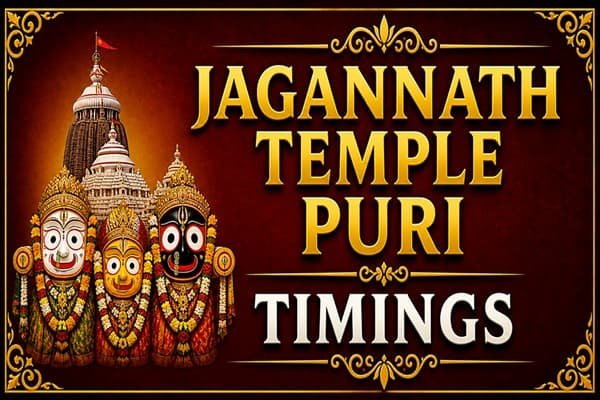
You stand at the Singha Dwara, the lion gate, and look up. The spire of the temple rises against the sky, its shadow nowhere to be found despite the bright sun. A priest climbs the wall barefoot, changing the flag. He does this every evening at sunset, just as his family has done for over 800 years. The air smells of incense and the sea. The sound of bells mixes with chanting. This is Shree Jagannath Temple Puri, one of the four holiest Char Dham pilgrimage sites in India. Dedicated to Lord Jagannath, the Lord of the Universe, this ancient temple draws millions of devotees each year.
The temple sits close to the Bay of Bengal in the town of Puri, Odisha. The main deities are Lord Jagannath, his elder brother Lord Balabhadra, and their sister Goddess Subhadra. Unlike most Hindu idols made of stone or metal, these are carved from sacred neem wood. Every 8 to 12 years, the idols are replaced in a secret ritual called Navakalebara, meaning “new body”. This rare event draws massive crowds. The temple is also famous worldwide for the annual Rath Yatra, or chariot festival, where the three deities ride on giant wooden chariots pulled by thousands of devotees through the Grand Road.
Shree Jagannath Temple Puri Daily Darshan Timings 2026
The temple follows a strict daily schedule that has been followed for centuries. Knowing these timings helps you plan your darshan without standing in long queues during closed periods.
The temple opens around 5:00 AM every day. The first ritual is the Mangala Aarti at about 5:00 AM. From 5:30 AM onwards, general darshan begins. The early morning hours between 5:30 AM and 7:30 AM are the best time for a peaceful darshan. The crowds are thin, and the atmosphere is deeply spiritual.
At around 7:30 AM, the temple prepares for the Gopala Ballava Puja. From 8:00 AM to 9:15 AM, darshan is closed to the public. The temple reopens at 9:15 AM for the Sakala Dhupa, the morning food offering. Darshan remains open from 9:15 AM to 11:15 AM.
Another break happens from 1:00 PM to 2:00 PM after the afternoon rituals. The temple then closes again for the Sandhya Aarti and evening rituals from 5:30 PM to 8:00 PM. During this time, darshan is not available. The final darshan of the day happens from 8:00 PM to 9:00 PM after the Sandhya Dhupa. The temple finally closes at 11:00 PM. On most days, the temple closes at 9:00 PM for general visitors.
The table below shows the full daily ritual schedule and darshan availability.
| Ritual / Seva | Approximate Timing | Darshan Status |
|---|---|---|
| Dwaraphita and Mangala Aarti | Around 5:00 AM | Darshan open |
| Mailam (removal of night attire) | Around 6:00 AM | Darshan open |
| Abakash (sacred bath of deities) | 6:00 AM to 6:30 AM | Darshan open |
| Mailam (fresh dress offering) | Around 6:45 AM | Darshan open |
| Sahanamela Darshan | 7:00 AM to 8:00 AM | Darshan open |
| Beshalagi | Around 8:00 AM | Darshan open |
| Rosha Homa, Surya Puja, Dwarapal Puja | 8:00 AM to 8:30 AM | Darshan open |
| Gopala Ballava Puja | Around 9:00 AM | Darshan closed until 9:15 AM |
| Sakala Dhupa (morning bhog) | Around 10:00 AM | Darshan open 9:15 AM to 11:15 AM |
| Madhyanha Dhupa (midday bhog) | 11:00 AM to 1:00 PM | Darshan open |
| Madhyanha Pahuda (rest time) | 1:00 PM to 1:30 PM | Darshan closed until 2:00 PM |
| Sandhya Aarti | Around 5:30 PM | Darshan closed 5:30 PM to 8:00 PM |
| Sandhya Dhupa (evening bhog) | 7:00 PM to 8:00 PM | Darshan open 8:00 PM to 9:00 PM |
| Mailam and Chandana Lagi | Around 8:30 PM | Darshan open |
| Badashringara Vesha and Bhoga | 9:30 PM to 10:30 PM | Darshan not available |
| Khata Seja Lagi and Pahuda | Around 12:00 AM | Temple closed |
Plan your visit for the early morning slot between 5:30 AM and 7:30 AM. You will avoid long queues and witness the beautiful morning rituals. If you cannot come early, the late evening slot between 8:00 PM and 9:00 PM is also relatively calm. Avoid the afternoon hours when the temple is either closed or extremely crowded.
Darshan Ticket Price and Types
Darshan at Shree Jagannath Temple is generally free for all devotees. General Darshan, also called Sarva Darshan, has no ticket fee. You simply join the queue and wait. During normal days, the wait is manageable. During weekends and festivals, the queue can stretch for two to three hours.
For devotees who prefer a faster experience, the temple offers a Special Darshan ticket costing ₹100 per person. This gives you priority entry through a separate queue. During busy days, this can save you an hour or more of waiting time.
VIP Darshan is also available at ₹500 per person. This option provides the fastest access with minimal waiting. VIP tickets are limited and are often booked quickly during festival seasons.
All special and VIP tickets must be purchased at the temple counter on the day of your visit. Online booking for darshan tickets is not available for this temple. Arrive early at the ticket counter to secure your pass, especially during weekends and festivals.
Mahaprasad at Jagannath Temple
The Mahaprasad of Jagannath Temple is one of the most sacred food offerings in Hindu tradition. It is prepared in the temple kitchen, which is believed to be the largest in the world. The kitchen has about 250 hearths, or chulis. Cooking is done in earthen pots placed one on top of another. Remarkably, the pot on the top cooks first. This method defies ordinary logic.
About 600 chefs and 400 assistants cook here daily. They prepare 56 different food items for nearly 20,000 devotees. On special occasions, they cook for 50,000 people. The food is first offered to Lord Jagannath. After the offering, it is considered Mahaprasad. Not a single bite is ever wasted.
Devotees can purchase Mahaprasad at the Ananda Bazaar, located inside the temple complex. You can also sit and eat there. The Prasad includes rice, dal, vegetables, sweets, and the famous khaja. Sharing Mahaprasad with other devotees is considered a sacred act. Many pilgrims feel their darshan is incomplete without receiving the Mahaprasad.
Major Festivals at Jagannath Temple
Rath Yatra is the most famous festival celebrated at the temple. It happens annually in June or July, on the second day of the Asadha month. The deities are taken out of the temple and placed on three giant wooden chariots. The chariot of Lord Jagannath has 16 wheels, that of Lord Balabhadra has 14, and Goddess Subhadra’s chariot has 12. Thousands of devotees pull the chariots with long ropes through the Grand Road to the Gundicha Temple, about 3 kilometers away. The journey is called the Bahuda Yatra. After nine days, the deities return to the main temple.
Snana Yatra is another important festival, held in June. The idols are brought out and bathed with 108 pots of water. After this bath, the deities are said to fall ill. They are kept in isolation for 15 days. This period is called Anasara. Devotees cannot see them. After 15 days, they reappear in a new form. This is the Navakalevara ritual, though it happens only every few years.
Other festivals include Chandan Yatra in summer, Makar Sankranti in January, Dola Purnima, and Pana Sankranti, the Odia New Year. During all festivals, Jagannath Temple timings may change. Crowds swell dramatically. If you plan to visit during a festival, book your accommodation well in advance and prepare for long waiting times.
Unique Facts and Mysteries
The temple has several fascinating features that continue to mystify visitors and scientists alike. The main spire of the temple casts no shadow at any time of the day. No matter where the sun is, the shadow simply does not fall on the ground.
The flag, called the Patita Pavana, perched on top of the temple, always flows in the opposite direction of the wind. If the wind blows from the sea, the flag blows towards the sea. This defies all logic.
The Sudarshan Chakra on the top of the temple, made of eight metals, appears to face you from every angle. No matter where you stand around the temple, the chakra seems to be looking directly at you.
No birds fly above the spire of the temple. Pigeons and crows are common around the rest of Puri, but they never circle or rest on the main temple roof. It is also said that aircraft do not fly directly over the temple.
Once you enter the temple through the Singha Dwara, the sound of the sea waves completely disappears. You cannot hear the ocean until you step back outside. This acoustic anomaly has been noted for centuries.
These mysteries add to the temple’s spiritual pull. Whether through divine intervention or ancient engineering, they make Shree Jagannath Temple unique in the world.
Architecture and Important Parts of the Temple
Built in the Kalinga style of architecture in the 12th century by King Ananta Varman Chodaganga Deva, the temple has four main parts. The Vimana is the inner sanctum where the idols sit on a raised stone pedestal called the Ratna Singhashana. The Jagamohana is the prayer hall. The Nata Mandapa is the dance hall. The Bhoga Mandapa is the offering hall.
Two huge concentric walls surround the shrine. The inner wall is called the Kurma Prachira. The outer wall, 20 to 24 feet high, is called the Meghanada Prachira. The outer wall has four gates. The east gate, Singha Dwara or Lion Gate, is the main entrance. The west gate is Vyaghra Dwara or Tiger Gate. The north gate is Hastidwara or Elephant Gate. The south gate is Aswadwara or Horse Gate.
Inside the complex, there are 76 smaller temples. The most important among them is the Vimala Temple. It is considered a Shakti Peetha. Interestingly, the Mahaprasad offered to Lord Jagannath is first offered to Goddess Vimala. Only then is it considered sacred. Other important shrines include the Lakshmi Temple, Surya Temple, and Bata Ganesha Temple under the sacred Kalpabata banyan tree.
The Aruna Stambha, a 34 foot high monolith pillar made of 16 sides, stands on the eastern side. It was brought from the Konark Temple by King Dibyasingha Deva. The 22 steps, or Baisi Pahacha, lead from the outer to the inner compound. Devotees believe sitting on these steps is a sacred duty.
Also Read : Tiruchanur Padmavathi Darshan 2026 Timings Online Booking and Sevas
Dress Code and Temple Rules
The temple follows a strict dress code. Non Hindus are not allowed to enter the temple premises. This rule is strictly enforced. You will be asked to prove your Hindu faith if your appearance is ambiguous.
For men, the dress code requires a dhoti with a kurta or an angavastram. Trousers and shirts are sometimes allowed, but traditional dress is always preferred. Shorts, sleeveless shirts, and jeans are strictly prohibited.
For women, the dress code requires a saree, a salwar kameez, or other traditional Indian clothing that covers the body properly. Western outfits like jeans, skirts, shorts, and sleeveless tops are not permitted.
Footwear must be removed before entering the temple. Free shoe stands are available near the gates. Leather articles, including belts and bags, are not allowed. Mobile phones and cameras are also prohibited. Free mobile phone lockers are available outside. Do not try to carry these items inside. Security checks are thorough.
Free battery operated vehicles are available for senior citizens and physically challenged persons from the Market Square to the North Gate. Wheelchair and ramp facilities are also available. Clean drinking water and first aid services are provided inside the complex.
How to Reach Jagannath Temple Puri
The temple is located on Grand Road in Puri town. By train, Puri Railway Station is just 2.8 kilometers away. From the station, you can take a taxi, auto rickshaw, or cycle rickshaw to the temple. The journey takes about 10 minutes.
By bus, the Puri Bus Stand is about 1.9 kilometers from the temple. Auto rickshaws are readily available. By air, the nearest airport is Biju Patnaik International Airport at Bhubaneswar, 60 kilometers away. From the airport, you can take a taxi directly to Puri. The drive takes about 1.5 hours. You can also take a bus or train from Bhubaneswar to Puri.
Accommodation Near the Temple
The temple administration manages several dharmashalas and guest houses close to the temple. These are clean, affordable, and convenient for pilgrims. You can book rooms online through the official website of the temple trust. Private hotels and lodges are also available near the temple, ranging from budget to premium options.
Staying near the temple allows you to attend the early morning Mangala Aarti easily. It also saves travel time during busy festival days. Booking accommodation in advance is highly recommended, especially during Rath Yatra and other major festivals.
Final Tips for a Peaceful Darshan
Visit on a weekday rather than a weekend. Tuesday and Friday are considered auspicious but are also very crowded. Arrive at the temple by 5:30 AM. This is the best time for a calm, unhurried darshan. Wear traditional clothing to avoid entry issues. Keep your mobile phone and camera in the locker. Do not carry leather items.
Carry minimal belongings. The crowd inside can be overwhelming, and it is easy to lose things. If you are traveling with elderly family members or young children, consider the special darshan ticket at ₹100. The extra cost is worth the comfort. Drink water before entering. There are drinking water stations inside, but you may not want to leave the queue once you are in it.
After darshan, spend time at the Ananda Bazaar. Eat the Mahaprasad. Sit under the Kalpabata tree. The temple is not just about the 30 seconds you spend in front of the deity. It is about the entire experience of faith, community, and peace.
Frequently Asked Questions
What are the Jagannath Temple Puri opening hours? The temple opens around 5:00 AM and closes around 11:00 PM. General darshan is available during specific slots throughout the day.
Which deities are worshipped at Jagannath Temple? Lord Jagannath, Lord Balabhadra, and Goddess Subhadra.
Is there a dress code for entering the temple? Yes, traditional Indian attire is required. Men must wear dhoti and kurta. Women must wear saree or salwar kameez.
How can I book special or VIP darshan tickets? Tickets must be purchased at the temple counter on the day of your visit. Online booking is not available.
What is Mahaprasad at Jagannath Temple? It is the sacred food offering made daily in the temple kitchen. It is available for devotees at Ananda Bazaar.
What is Navakalevara? It is the ritual of replacing the wooden idols of the deities every 8 to 12 years.
When is the famous Rath Yatra festival celebrated? It is celebrated annually in June or July.
Are there online accommodations near the temple? Yes, rooms can be booked online through the official portal of the temple trust.
What are the main daily rituals at Jagannath Temple? Key rituals include Mangala Aarti, Abakash, Sakala Dhupa, Madhyanha Dhupa, Sandhya Aarti, and Khata Seja Lagi.
Where is Jagannath Temple located? Shree Jagannath Temple, Grand Road, Puri, Odisha 752001.
Conclusion
Shree Jagannath Temple Puri is not just a temple. It is a living, breathing center of faith that has operated continuously for over 800 years. The daily rituals have not changed. The mysteries remain unsolved. The Mahaprasad continues to feed thousands. Plan your visit using this guide. Follow the dress code. Arrive early. Respect the traditions. The Lord of the Universe is waiting to bless you.