
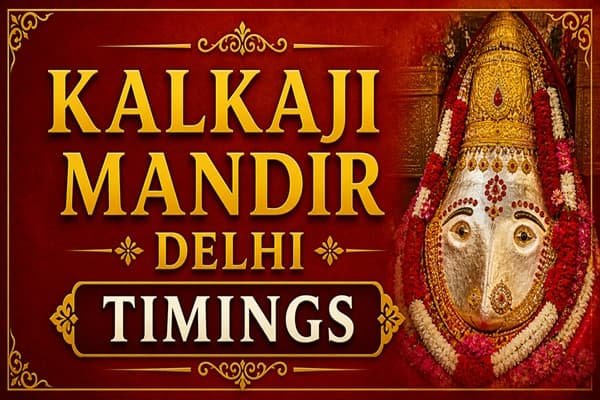
You step out of the metro station and immediately feel the energy shift. The air smells of incense and marigolds. The sound of bells and chanting grows louder as you approach. Ahead, the white marble temple rises against the South Delhi sky, its pyramid shaped tower gleaming in the morning light. This is Kalkaji Mandir, one of the oldest and most revered Shakti Peethas in North India. Dedicated to Goddess Kalka, a fierce and powerful form of Maa Durga also known as Kali, this temple draws thousands of devotees daily. They come seeking blessings, wish fulfillment, and a connection to the divine feminine.
Located near Nehru Place and just opposite the famous Lotus Temple, Kalkaji Mandir sits in the heart of South Delhi. The area is bustling with offices, markets, and residential colonies. Yet the moment you enter the temple complex, the chaos of the city fades away. The marble floors are cool under your bare feet. The high ceilings echo with prayers. The red velvet drapes framing the deity’s seat add a touch of royal reverence. For centuries, this has been a place where the faithful bring their hopes, their fears, and their deepest desires.
Kalkaji Mandir Daily Darshan Timings 2026
The temple opens its doors early, long before the sun rises over Delhi. The daily schedule is designed to accommodate everyone from the early morning devotee seeking peace to the evening visitor coming straight from work. Knowing these timings helps you plan a smooth and spiritually fulfilling visit.
The temple opens at 4:00 AM every day. This early hour is known as the Brahma Muhurta, considered highly auspicious for prayers and meditation. From 4:00 AM to 5:30 AM, the temple holds a special session before the formal rituals begin. Then from 5:30 AM to 6:30 AM, the temple closes for Shringaar, the dressing and decoration of the deity. You cannot enter during this hour.
Morning darshan resumes at 6:30 AM and continues until 11:45 AM. This is the most popular time for working professionals and families. The temple takes a short break from 11:45 AM to 12:15 PM for the Bhog offering. At noon, priests offer a meal to the goddess. The temple then reopens from 12:15 PM to 3:00 PM for afternoon darshan. Another cleaning and maintenance break happens from 3:00 PM to 4:00 PM. The temple is completely closed during this hour.
Evening darshan runs from 4:00 PM to 7:30 PM. Then from 7:30 PM to 8:30 PM, the temple closes again for evening Shringaar. The final darshan session of the day takes place from 8:30 PM to 11:30 PM. The temple finally closes for the night at 11:30 PM. On Tuesdays and Saturdays, which are considered especially auspicious for Maa Kali, the temple often stays open later, sometimes until midnight. During the festival of Navratri, the temple may remain open for extended hours or even overnight for special jagrans, or night long prayer sessions.
The best time for a peaceful, uncrowded darshan is between 4:00 AM and 6:00 AM. The temple is quiet. The queues are short or nonexistent. You can stand before the goddess and pray without feeling rushed. If you cannot wake up that early, the late evening session after 9:00 PM is also relatively calm. Avoid visiting between 10:00 AM and 2:00 PM on weekends or during Navratri if you want to avoid massive crowds.
Kalkaji Mandir Aarti Timings 2026
The aarti ceremonies are the heartbeat of the temple. These daily rituals fill the sanctum with sound, light, and devotion. Attending an aarti at Kalkaji Mandir is an experience that stays with you long after you leave.
The first aarti of the day is the Mangala Aarti, performed at 4:30 AM. This takes place immediately after the temple opens. The atmosphere is dark and quiet, lit only by oil lamps. The priests chant in deep voices. Devotees who attend this aarti say it sets a peaceful tone for their entire day. It is the most intimate of all the aartis.
The Shringar Aarti happens at 7:00 AM, right after the deity has been dressed and decorated. The goddess appears in her full glory, adorned with fresh clothes, jewelry, and flower garlands. This aarti is visually stunning. The morning sunlight streams through the doorways, catching the gold and silver ornaments.
The Bhog Aarti takes place at 12:00 PM, just before the midday break. This aarti is associated with the food offering. The priests present a meal to the goddess. Many devotees wait to receive this food as prasad after the aarti. The Bhog Aarti is shorter but deeply meaningful.
The Sandhya Aarti, or evening aarti, is performed at 7:00 PM. This is the most crowded and vibrant aarti of the day. The temple fills with devotees. The priests ring large bells. Conch shells blow. The lamps are lit and waved in a circular motion before the deity. The energy is electric. If you can only attend one aarti, make it this one. But arrive at least 30 minutes early to get a good spot.
The final aarti of the day is the Shayan Aarti, at 10:30 PM. This is the bedtime ritual for the goddess. The priests prepare the deity for rest. The temple becomes quiet again. Devotees who attend this aarti describe a profound sense of peace and completion. After this aarti, the temple remains open for darshan for another hour before finally closing at 11:30 PM.
During Navratri and other major festivals, special aartis are held with additional rituals, bhajans, and extended chanting. The temple trust also organizes jagrans, or all night devotional singing sessions, during these times. If you attend a festival aarti, be prepared for very large crowds and long waiting times. The spiritual energy, however, is unmatched.
Kalkaji Mandir VIP Darshan Pass
Waiting in long queues can be exhausting, especially for senior citizens, families with young children, or those on a tight schedule. The temple offers a VIP Darshan Pass to help devotees have a smoother, faster experience. This pass is especially useful during Navratri, weekends, and other peak times.
The VIP pass costs between ₹150 and ₹300 per person. The exact price depends on the season and the specific VIP service you choose. With this pass, you enter through a separate, much shorter queue. You reach the sanctum faster. You also get a few extra moments near the deity for your prayers.
You cannot book the VIP pass online. You must purchase it directly at the temple counters on the day of your visit. During normal days, the VIP counter is open throughout temple hours. During festivals, the counter may have specific timings. Look for signs or ask temple staff for directions to the VIP booking counter.
Be careful of frauds. Some people standing outside the temple may approach you claiming to sell VIP passes at higher prices or promising guaranteed entry. Do not buy from them. Only purchase passes at the official counters inside the temple premises. The temple does not authorize any third party to sell passes on its behalf.
The VIP pass is highly recommended during the nine days of Navratri. During this period, regular queues can stretch for hours, sometimes over three to four hours. The VIP queue, while still having some wait, usually moves much faster. For elderly devotees or those with physical difficulties, the VIP pass is almost essential during festivals.
If you are visiting on a regular weekday, especially early morning or late evening, you may not need a VIP pass at all. The crowds are manageable. The regular queue moves steadily. Save your money for offerings or donations instead.
History and Legend of Kalkaji Mandir
The story of Kalkaji Mandir stretches back thousands of years. According to legend, the temple existed even during the time of the Mahabharata. The Pandava brothers, during their years of exile, are believed to have worshipped here. Local folklore also says that the Kauravas performed rituals at this very spot. This makes the temple not just a place of worship but a living link to ancient India.
The main legend associated with the temple involves a battle between the gods and two powerful giants. The giants were terrorizing the mythical gods who lived in the area around the Aravalli Hills, where the temple now stands. The gods complained to Lord Brahma. He delegated the task of destroying the giants to Goddess Parvati. She brought forth another goddess named Kaushki Devi, who successfully killed the giants.
However, a new problem arose. Every drop of the giants’ blood that touched the dry earth gave birth to thousands more giants. Kaushki Devi could not fight so many alone. Her mother, Maa Parvati, then brought forth another incarnation of herself, Kali. Kali had the power to change her size. She enlarged her mouth so that her upper lip touched the sky and her lower lip touched the foothills. In this form, she drank up all the blood that fell from the giants killed by Kaushki Devi. Together, the two goddesses eliminated the menace completely. Pleased by the praise of the gods, Kali decided to dwell permanently at this spot.
Historians have a more grounded but still fascinating account. The current temple structure is believed to have been built around 1764 AD by the Marathas. In 1816, Mirza Raja Kidar Nath, the treasurer of Mughal King Akbar Shah II, added his own touches to the shrine. The marble structure that stands today was largely built in the 1960s, funded through donations from countless devotees.
The land on which the temple stands belongs to the Thok Jogians and Shamlat Thok Brahmins. These families have provided the priests who carry out the worship rituals for generations. Even today, the same families are involved in the temple’s administration and daily poojas.
The temple is considered one of the Siddha Peethas, meaning a place where spiritual powers manifest strongly and where devotees’ wishes are fulfilled. It is also called the Jayanti Peetha or Manokamna Siddha Peetha. Manokamna means wish. Devotees believe that sincere prayers made here are answered by the goddess. This belief draws countless people seeking solutions to problems related to marriage, career, health, and finances.
Who is Maa Kalka Ji
Maa Kalka Ji is a powerful and fierce form of Goddess Durga. She is commonly known as Kali. Her name comes from the Sanskrit word kal, which means time, death, or black. She represents the destructive aspect of the divine feminine, the power that destroys evil, ego, and negativity.
In images and statues, she is depicted with dark blue or black skin. She has a fearsome appearance with a garland of skulls around her neck and a skirt made of severed arms. She holds a sword in one hand and the severed head of a demon in another. Her tongue hangs out red and bloody. This is not a symbol of evil but of her victory over the demon Raktabeej. Every drop of his blood, when it fell to the ground, created another demon. Kali drank the blood before it could touch the earth, saving the universe.
Despite her terrifying appearance, she is also a loving mother to her devotees. She protects them from harm, removes obstacles from their path, and grants their wishes. She is particularly kind to those facing injustice, fear, or persecution. Many devotees turn to her when they feel powerless against larger forces.
At Kalkaji Mandir, she is worshipped in a more peaceful form compared to the ferocious depictions in Bengal. The idol here is carved from stone, with her name engraved in Hindi on the base. A stone trident stands before her, symbolizing her power. Two red sandstone tigers flank the idol, representing the strength and courage she bestows upon her devotees.
Tuesday and Saturday are considered especially auspicious for worshipping Maa Kali. Many devotees fast on these days or offer special prayers. Red flowers, particularly hibiscus, and red cloth are favorite offerings. The color red represents her fierce energy and the blood of the demons she destroyed.
Architecture of Kalkaji Mandir
The temple is a beautiful example of North Indian temple architecture blended with marble craftsmanship. The main structure is built of brick, coated with plaster, and finished with white marble. The marble gives the temple its pristine, elegant appearance that stands out against the busy South Delhi neighborhood.
The most distinctive feature of the temple is the central chamber. It has 12 sides, each measuring 24 feet across. Each of these 12 sides has its own entrance door, all lined with marble. These 12 doors open out to a marble gallery that runs around the chamber. The gallery ends in three arched exterior doorways on each side, totaling 36 arched entrances around the temple. This unique design allows for smooth flow of devotees even on the busiest days.
Above the central chamber rises a pyramid shaped tower. At its peak is a gold plated kalash, a sacred pinnacle that is visible from a distance. The tower adds a majestic vertical element to the otherwise low rise structure of South Delhi.
Inside, the main sanctum houses the idol of Maa Kali on a marble pedestal. The pedestal and the surrounding railings bear inscriptions in the Nasta’liq style of Persian calligraphy. This is a unique blend of Islamic and Hindu artistic traditions, reflecting Delhi’s composite culture. The idol itself has the goddess’s name engraved in Hindi.
The temple complex also includes smaller shrines dedicated to Lord Hanuman and Lord Shiva. A large assembly hall accommodates gatherings, special ceremonies, and community feasts. The outer courtyard serves as an open space for large crowds during festivals.
The temple trust has added modern facilities over the years. Clean drinking water stations are available. Shoe storage counters operate near the entrance. A first aid room handles medical emergencies. The entire complex is kept spotlessly clean by a dedicated staff.
How to Reach Kalkaji Mandir
Getting to the temple is very easy. Its South Delhi location is well connected by all modes of transport.
By Metro: This is the best option for most visitors. The Kalkaji Mandir Metro Station is on the Violet Line and also connects to the Magenta Line. The station is just a 2 minute walk from the temple entrance. Exit the station and turn right. You will see the temple’s tower ahead. Metro fares from most parts of Delhi range from ₹10 to ₹60. Trains run from about 6 AM to 11 PM daily. During Navratri, the Delhi Metro sometimes extends its hours to accommodate devotees.
By Bus: Several DTC bus routes stop near the temple. Routes 425, 433, 522, 534, and others have a stop at Kalkaji Mandir. The bus stop is about a 5 minute walk from the temple entrance. Buses are the cheapest option but can be crowded and slow.
By Car or Taxi: The temple has a designated parking area. However, parking fills up quickly on weekends and during festivals. Charges apply. Ride sharing services like Uber and Ola operate regularly in this area. You can use the app to book a direct trip to the temple. Auto rickshaws are also available from anywhere in South Delhi.
From the Airport: Indira Gandhi International Airport is about 18 to 20 kilometers away. The easiest option is to take the Airport Express Metro to New Delhi station, then change to the Violet Line. The total journey takes about 50 to 60 minutes. A taxi from the airport costs between ₹400 and ₹600 depending on traffic.
From Hazrat Nizamuddin Railway Station: This is the nearest major railway station, about 7 to 8 kilometers away. A taxi or auto rickshaw takes 20 to 30 minutes and costs ₹80 to ₹150. You can also take a metro from the station.
The temple address is: Kalkaji Mandir, Block 9, Kalkaji, New Delhi, Delhi 110019. The location is near the famous Lotus Temple and Nehru Place. After visiting Kalkaji, you can easily walk or take a short auto ride to the Lotus Temple, which is about 3 kilometers away.
Dress Code and Temple Etiquette
The temple does not have a strictly enforced dress code, but modesty is appreciated. The temple is a place of worship, and traditional attire shows respect.
Men should wear full pants, trousers, or dhoti kurta. Shirts should have sleeves. Avoid shorts, torn jeans, sleeveless shirts, or gym wear. Women should wear sarees, salwar suits, churidars, or long skirts with a dupatta. Avoid shorts, mini skirts, sleeveless tops, or tight revealing clothes.
Remove your footwear before entering the main temple premises. Shoe storage counters operate near the entrance. They charge a small fee of ₹5 to ₹10. Some counters are free. You can also leave your shoes in your car if you drive. Do not carry leather items like belts or bags inside the sanctum.
Keep your mobile phone switched off or on silent mode. Do not take calls inside the temple. Photography is strictly prohibited in the inner sanctum and during aarti ceremonies. You may take photos of the exterior and the outer courtyard. Do not take photos of other devotees without their permission.
Maintain silence inside the prayer halls. The sanctum is a place for meditation and prayer, not conversation. Follow the queue discipline. Do not push or rush. The temple volunteers manage the flow of devotees. Listen to their instructions. Do not touch the deity or the offerings. The priests will give you prasad after the rituals.
If you are visiting with children, keep them close and supervise them. Do not let them run around or shout. Teach them to respect the sacred space. The temple is generally safe and family friendly.
If you wish to make an offering, you can buy flowers, coconuts, chunri, or other items from the shops outside the temple. Prices are reasonable and fixed. Avoid buying from unauthorized vendors who may try to overcharge. Temple approved shops are located near the entrance.
Best Time to Visit
Choosing the right time to visit can make your experience much more pleasant.
For Peaceful Darshan: Early morning between 4:00 AM and 7:00 AM is the best time. The temple is quiet. The crowds are minimal. You can pray without feeling rushed. The early morning aarti at 4:30 AM is especially beautiful. If early morning is not possible, late evening after 9:00 PM is also relatively calm.
For Festival Experience: Navratri is the most important festival at Kalkaji Mandir. The temple is beautifully decorated. Special aartis, jagrans, and cultural programs take place. However, the crowds during Navratri are enormous. Queues can stretch for hours. If you can handle crowds and long waits, the spiritual energy during Navratri is unmatched.
For Pleasant Weather: October to March is the best time weather wise. Delhi’s winters can be cold but are generally pleasant for temple visits. The summer months from April to June are extremely hot, with temperatures often exceeding 40 degrees Celsius. If you must visit in summer, come early morning or after sunset.
To Avoid Crowds: Visit on a weekday, preferably Monday, Wednesday, or Thursday. Avoid Sundays and public holidays. Avoid Tuesdays and Saturdays if you want to avoid crowds, though these are auspicious for Maa Kali worship. The afternoon session from 12:15 PM to 3:00 PM is generally less crowded than the morning or evening sessions.
During major festivals like Navratri, Diwali, and Durga Puja, the temple experiences peak crowds. If your schedule is flexible, visit a few days before or after the festival dates instead of on the exact festival day. The decorations and festive spirit remain for several days, but the crowds are more manageable.
Kalkaji Mandli Delhi By Metro
The Kalkaji Mandir Metro Station is the most convenient way to reach the temple. Here is how to reach from different parts of Delhi.
From North Delhi:
-
Take the Violet Line from Kashmere Gate station
-
Travel towards Escorts Mujesar or Raja Nahar Singh
-
Get off at Kalkaji Mandir station
-
The journey takes about 30 to 40 minutes
From South Delhi:
-
Board the Violet Line from Saket or other South Delhi stations
-
Travel towards Kashmere Gate or Raja Nahar Singh
-
Alight at Kalkaji Mandir station
-
Takes about 15 to 20 minutes
From Central Delhi:
-
Take the Yellow Line to Central Secretariat
-
Change to the Violet Line
-
Board a train towards Escorts Mujesar
-
Get off at Kalkaji Mandir station
-
Takes about 35 to 45 minutes
From Noida or Ghaziabad:
-
Take the Blue Line to Mandi House
-
Change to the Violet Line
-
Travel to Kalkaji Mandir station
-
Takes about 50 to 60 minutes
The station is located on the Violet Line. It is also an interchange for the Magenta Line. The temple is literally a two minute walk from the station. Look for Exit Gate 2. Follow the signs. You can also ask any station staff for directions.
The first metro train arrives around 6 AM. The last train departs around 11 PM. This matches the temple’s timing, except for the very early morning session starting at 4 AM. If you want to attend the 4:30 AM aarti, you will need to take a taxi or auto as the metro does not operate at that hour.
Metro fares are affordable. Expect to pay between ₹10 and ₹60 depending on your starting station. Smart cards offer a small discount. You can purchase a token for a single journey or use a smart card for multiple journeys.
Kalkaji Mandli Delhi Nearest Railway Station
Travelers arriving by train should head to Hazrat Nizamuddin Railway Station. This is the closest major railway station to the temple.
Distance: Hazrat Nizamuddin is only 7 to 8 kilometers from the temple. A taxi or auto rickshaw takes 20 to 30 minutes depending on traffic. The fare is approximately ₹80 to ₹150 for an auto. Taxis charge between ₹200 and ₹300.
Metro Option: You can also take the metro from Hazrat Nizamuddin station. Board the Violet Line and travel towards Kashmere Gate or Escorts Mujesar. Get off at Kalkaji Mandir station. The journey takes about 15 to 20 minutes.
From New Delhi Railway Station:
-
Distance is about 12 kilometers
-
Take the Yellow Line from New Delhi station to Central Secretariat
-
Change to the Violet Line
-
Travel to Kalkaji Mandir station
-
Total journey time around 40 minutes
From Old Delhi Railway Station:
-
Distance is about 15 kilometers
-
Take the Yellow Line from Chandni Chowk station
-
Change at Rajiv Chowk to the Violet Line
-
Travel to Kalkaji Mandir station
-
Total time around 50 minutes
All major long distance trains stop at either Hazrat Nizamuddin or New Delhi station. Pre paid taxi counters are available at both stations. You can prepay and get a taxi to the temple without haggling.
Also Read : Tadbund Hanuman Temple Vehicle Pooja 2026 Timings Darshan and Price Guide
Is Kalkaji Mandli Delhi A Shakti Peeth
This is a common question among devotees. The answer is somewhat complex. Traditionally, the Shakti Peeth in Delhi is considered to be the Yogmaya Temple in Mehrauli. However, many devotees and some religious scholars believe that Kalkaji Mandir is also a Shakti Peeth.
According to legend, the various Shakti Peethas mark the spots where body parts of the Goddess Sati fell. One version of the legend states that Sati’s right toe or her ankle ornament fell at the site of Kalkaji Mandir. Another version says that her knee fell here. The temple is sometimes referred to as the Jayanti Peetha.
Whether officially classified as a Shakti Peeth or not, the temple is undoubtedly a Siddha Peetha. A Siddha Peetha is a place where spiritual powers are easily accessible and where devotees’ wishes are fulfilled. The energy here is palpable. Thousands of devotees report that their sincere prayers are answered. For practical purposes, the distinction matters less than the faith of the devotees who throng the temple daily.
Dress Code Information
The temple maintains a modest atmosphere. There is no official dress code board at the entrance, but certain clothing is considered inappropriate. It is best to dress traditionally.
Men should wear a kurta pajama or trousers and a shirt with sleeves. Dhotis are also acceptable. Do not wear shorts, sleeveless t shirts, or torn jeans. Avoid clothing with offensive prints or slogans.
Women have slightly more flexibility but should still dress modestly. Sarees are ideal. Salwar kameez suits are also very common. Long skirts or dresses that cover the knees and shoulders are acceptable if traditional wear is not available. Avoid short skirts, sleeveless tops, low cut necklines, or tight clothing that outlines the body.
The temple provides cloth wraps at the entrance for women who are not dressed appropriately. However, it is better to come prepared. The wraps are basic and may not be comfortable for extended wear.
Children should also dress modestly. Traditional attire for children is always appreciated.
Footwear must be removed before entering the main temple area. Socks are allowed. If you find the marble floor cold or hot, you may wear socks. There is a designated shoe storage area near the entrance. You will receive a token for your shoes. Keep the token safely. Collect your shoes when you leave.
Kalkaji Mandli Delhi Closing Time
The temple closes at 11:30 PM on most days. However, the schedule has some variations. The final darshan session of the day runs from 8:30 PM to 11:30 PM. After the Shayan Aarti at 10:30 PM, the temple remains open for another hour for devotees to have darshan.
On Tuesdays and Saturdays, the temple often stays open a little later, sometimes until midnight. During Navratri and other major festivals, the closing time may be extended further. The temple may remain open all night during special jagrans.
It is always a good idea to call the temple office or check their official social media pages for any changes to the schedule, especially before visiting during festival periods. The phone number for the temple is 092050 84060.
The afternoon break timings are strictly followed. The temple closes from 11:45 AM to 12:15 PM for Bhog offering and from 3:00 PM to 4:00 PM for cleaning. Do not come during these breaks expecting entry. The doors are completely shut.
Conclusion
Kalkaji Mandir is more than a temple. It is a living embodiment of faith that has survived for centuries. The white marble structure has witnessed the rise and fall of empires. It has seen Delhi transform from a medieval city to a modern metropolis. Through it all, the goddess has continued to receive the prayers of her devotees. Their wishes have been fulfilled. Their fears have been calmed.
Whether you come seeking wish fulfillment, spiritual peace, or simply a moment of quiet in a chaotic city, Kalka Ji Mandir welcomes you. The doors open at 4 AM. The aarti bells ring at regular intervals. The priests chant the same mantras that have been chanted for generations. Plan your visit using this guide. Arrive early. Dress modestly. Keep your phone silent. Open your heart. The goddess is waiting.
Jai Maa Kalka.