
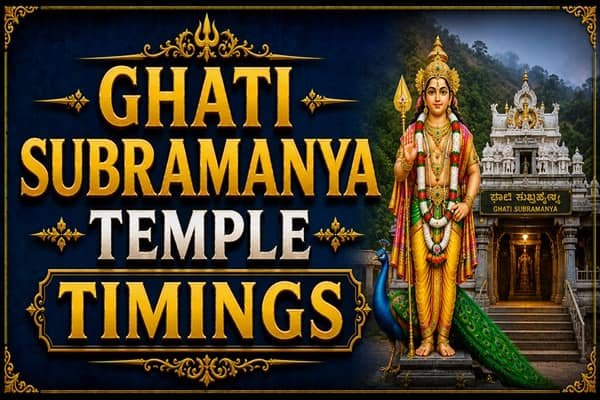
The Ghati Subramanya Temple sits about sixty kilometers north of Bangalore, in the village of S.S. Ghati, Doddaballapur Taluk. The city is behind you. The fields open. The hills rise. The temple is not on a high peak. It is in a valley, between rocks. The deity is not one. It is two. Lord Subramanya faces east, in the form of a seven headed serpent. Lord Narasimha faces west, carved on the back of the same stone. A mirror is placed behind the idol. You see both at once. That is the uniqueness. Not Subramanya alone. Not Narasimha alone. Both together. The serpent and the lion. The son of Shiva and the avatar of Vishnu. In one stone.
The temple is one of the three famous Naga Kshetras of Karnataka. Kukke Subramanya is the beginning. Ghati Subramanya is the middle. Nagalamadike is the end. The legend says that Subramanya came to earth in the form of a serpent to atone for imprisoning Brahma. As a serpent, he was vulnerable to Garuda. He prayed to Vishnu for protection. Vishnu came as Narasimha. He guarded him. The stone remembers.
Daily Darshan Timings for 2026
The temple opens at 6:00 AM every day. The morning darshan runs from 6:00 AM to 12:00 PM. The early morning hours, between 6:00 AM and 8:00 AM, are the best. The crowd is light. The air is cool. The Abhishekam is at 8:30 AM. The Mahamangalarathi is at 10:30 AM.
The temple then closes for an afternoon break from 12:00 PM to 4:00 PM. During these four hours, the sanctum remains closed. The priests perform internal rituals. Do not come during these hours expecting darshan.
The evening darshan runs from 4:00 PM to 9:00 PM. The evening Mahamangalarathi is at 8:30 PM. The temple closes at 9:00 PM.
Pooja and Seva Ticket Prices for 2026
General darshan is free. Special darshan costs ₹50. This gives you priority entry. The queue is shorter. The waiting time is less.
Kumkuma Archana costs ₹10. This is the simplest offering. Mudi, the hair offering, costs ₹20. Devotees offer their hair as a vow. Vahana Pooja for a two wheeler costs ₹25. For a heavy vehicle, it costs ₹50. Tulabhara costs ₹50. You offer grains, fruits, or money equal to your weight. Sahasranama Archana costs ₹50. The thousand names of the deity are chanted.
Ksheerabhisheka, the milk offering, costs ₹100. Panchamrutha Abhisheka costs ₹200. The five nectars are milk, curd, honey, ghee, and sugar. Rudrabhisheka costs ₹300. This is a powerful ritual. The priests chant the Rudram. The lingam is bathed.
Sarpa Seva costs ₹750. This is for relief from Sarpa Dosha, serpent related afflictions. Samuhika Ashlesha Bali costs ₹500. This is a group ritual performed on Ashlesha Nakshatra days.
Prakarotsava costs ₹1,001. Ekadasha Rudrabhishek costs ₹2,001. Abhisheka Shashwatha Seva, a yearly grand offering, costs ₹2,001. Kalyana Mantapa rent is ₹3,000 per day. Samuhika Sarpa Samskara costs ₹4,000.
Annadana for one day costs ₹5,001. This sponsors a free meal for devotees. Navagraha or Sarpa Shanti, along with Ashlesha Bali, costs ₹5,001. Pratyeka Sarpa Samskara, an individual serpent related ritual, costs ₹10,001. Kalyanotsavam Seva, the grand wedding ceremony, costs ₹15,000. Shashwata Seva for one day per year costs ₹1,50,001.
All bookings must be done at the temple counter. There is no online booking. Arrive early.
The Mirror and the Two Deities
The main idol is a single stone. On the front, Subramanya stands, with six faces and twelve arms. The posture is that of a serpent. On the back, Narasimha is carved, tearing the demon. The mirror is placed so that devotees see both. The reflection is the connection. Subramanya is the son. Narasimha is the protector. The son prays. The father guards. That is the theology of this place. Not separation. Union.
Also Read : Surapura Dada Bholad Timings 2026: Darshan Booking, Ticket Price & Guide
Festivals Celebrated at the Temple
Brahma Rathotsav is in December or January. The chariot festival. The idol is taken out. The ropes are pulled. The crowd is massive.
Nagara Panchami is in July or August. The festival of serpents. The snake idols are worshipped. The milk is poured. The turmeric is applied.
Narasimha Jayanti is in April. The birth of Narasimha. The temple is decorated. The poojas are elaborate.
Theppotsava, the float festival, is in January or February. The idol is taken to the temple tank. The lamps are lit. The reflection on the water is beautiful.
Champa Shashti is in November. Skanda Shashti is in January or February. Both are festivals of Subramanya.
How to Reach the Temple
By bus, BMTC and KSRTC buses run from Bangalore to Doddaballapur. The fare is about ₹36 to ₹45. From Doddaballapur, take a shared auto. The fare is about ₹20. A private auto costs about ₹200 one way.
By car, the temple is about sixty kilometers from Bangalore. The drive takes about one and a half hours. The roads are good. Free parking is available near the temple.
By train, the nearest station is Doddaballapur, about twelve kilometers from the temple.
Accommodation Near the Temple
Yatri Nivas is a government run guest house. The rooms are simple and affordable. Krishna Kutira is opposite the temple. SR Valley Resort and Green Valley Resort are a few kilometers away.
If you want more options, stay in Doddaballapur. OYO JP Vaibhava, Karavali Paradise, and Nature’s Village are good choices. During festivals, book at least two weeks in advance.
Best Time to Visit
The best months are October through February. The weather is pleasant. The summer heat of Karnataka is absent. The best days are weekdays, Tuesday through Thursday. Weekends are crowded. The best time of day is early morning, between 6:00 AM and 8:00 AM. The Abhishekam at 8:30 AM is worth attending.
A Final Word for First Time Visitors
The Ghati Subramanya Temple is not large. The gopuram is not tall. The crowd is not as large as Kukke. But the stone is unique. The mirror is unique. You see both deities at once. Subramanya is the serpent. Narasimha is the lion. The serpent is wisdom. The lion is courage. You need both. That is the teaching. Come early. Stand before the mirror. See your own reflection between the two gods. That is the darshan. That is the blessing.