
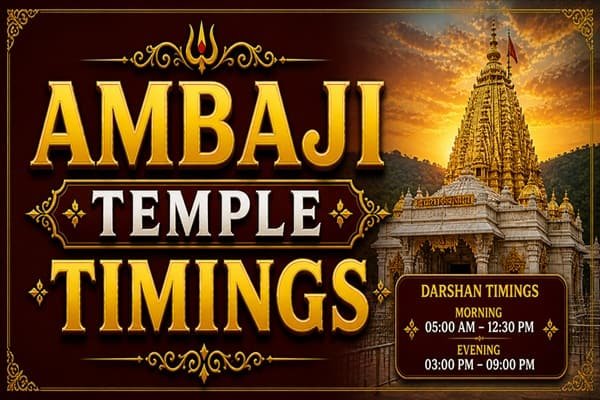
The Ambaji Temple sits in the Aravalli hills, on the border of Gujarat and Rajasthan. The air is dry. The hills are rocky. The temple is not grand in the way of the South Indian gopurams. It is modest. But the power here is not in the stone. It is in the absence of stone. There is no idol in the sanctum. Instead, a Shree Yantra, a sacred geometric diagram, is worshipped. The Yantra is gold plated. It rests in a cave like niche called the Gokh. This is one of the fifty one Shakti Peethas. The heart of Sati fell here. The goddess is not seen. She is felt. That is the uniqueness of Ambaji.
The temple is also called Shri Arasuri Ambaji Mata Temple. The town is small. The crowds are large, especially during Navratri. The temple is managed by a trust. The facilities are well organized. The bhojanalaya serves affordable meals. The ropeway to Gabbar Hill helps the elderly. The temple is not a single building. It is a complex of courtyards, mandaps, and the main sanctum with the Yantra. The golden kalash on top of the temple weighs over three tonnes. You can see it from a distance.
Daily Darshan and Aarti Timings for 2026
The temple opens at 7:00 AM every day. The morning darshan runs from 7:00 AM to 11:30 AM. The early morning hours are the best. The crowd is light. The hill air is cool. The morning aarti is at 6:00 AM, before the temple officially opens. Devotees gather outside. The doors open at 7:00 AM.
The temple then closes for a break from 11:30 AM to 12:30 PM. During this one hour, the sanctum remains closed. The priests perform internal rituals. Do not come during this hour expecting darshan.
The afternoon darshan runs from 12:30 PM to 4:30 PM. The evening darshan runs from 6:30 PM to 9:00 PM. The evening aarti is at 6:00 PM. The Rajbhog Aarti is at 12:00 PM. The Shayan Aarti is at 9:00 PM.
The darshan timings vary slightly by season. In summer, the evening darshan starts later. In winter, it starts earlier. The temple is open every day of the week. There is no entry fee.
The Sacred Yantra
The main object of worship is not an idol. It is a Shree Yantra, also called the Shakti Visa Yantra. The Yantra is a geometric diagram representing the goddess. It is gold plated. It is installed in a small cave like niche called the Gokh. The niche is dark. The Yantra glows in the lamp light.
The Yantra is believed to contain the 51 Bijpatras, representing the 51 Shakti Peethas. The Yantra has never been photographed. The temple maintains strict rules about photography. The mystery of the Yantra adds to the power of the place.
Bhojanalaya Timings and Meal Charges
The temple trust runs Shree Ambika Bhojanalaya. This is a dining hall for pilgrims. The food is simple, vegetarian, and affordable. The bhojanalaya is open from 10:00 AM to 10:00 PM. A full meal costs ₹165. A children’s meal for those under ten costs ₹115. A full meal with sweet costs ₹215. A children’s meal with sweet costs ₹165.
The bhojanalaya is clean and well managed. During Navratri, the queues are long. But the service is efficient. The food is not fancy. It is filling. That is the point.
Ropeway to Gabbar Hill
Gabbar Hill is the sacred hill behind the temple. This is believed to be the original spot where the heart of Sati fell. A holy flame still burns on the hilltop. The climb is 999 steps. For those who cannot climb, a ropeway is available. The ropeway is called Udan Khatola. It started in 1998. The ride takes a few minutes. The views of the Aravalli hills are beautiful.
The ropeway is especially useful for elderly devotees and families with small children. During Navratri, the queue for the ropeway can be long. But it is still faster than climbing.
Also Read : Shri Nageshwar Jyotirlinga Gujarat Timings 2026: Abhishekam, Darshan & Travel Guide
Festivals Celebrated at the Temple
Navratri is the biggest festival. Aswin Sud Navratri falls in September or October. Chaitra Navratri falls in March or April. During Navratri, the temple is packed. The town fills with pilgrims. Garba is played in the streets. The aartis are extended. The darshan timings change. The temple trust announces the special schedule a few days before.
Bhadrapad Poonam Mela is another important festival. This is held in August or September. The full moon day is considered especially auspicious. Thousands of devotees visit. Posh Sud Poonam in December or January and Kartik Sud in October or November also draw large crowds.
How to Reach the Temple
By air, the nearest airport is Sardar Vallabhbhai Patel International Airport in Ahmedabad, about 175 kilometers from Ambaji. From the airport, take a taxi. The drive takes about three to four hours.
By train, the nearest station is Abu Road Railway Station, about 21 kilometers from the temple. Abu Road is connected to Delhi, Mumbai, Jaipur, and Ahmedabad. From the station, take a taxi or auto. The ride takes about thirty minutes.
By road, Ambaji is well connected. Buses run from Ahmedabad, Palanpur, and Mount Abu. The bus station is one kilometer from the temple. From the bus station, take an auto. The ride takes five minutes.
The address is Ambaji, Taluka Danta, District Banaskantha, Gujarat, 385110.
Accommodation Near the Temple
Parvati Pranam Dharamshala is a popular option. The rooms are clean. The prices are low. Ambaji Shakti Pathikashram is another trusted stay. Nandni Ashram is budget friendly. Sitaba Sadan offers simple lodging. Shree Ganesh Bhavan is close to the temple.
During Navratri, book your accommodation at least two to three weeks in advance. The town fills up. The dharamshalas are full. The hotels are expensive.
A Final Word for First Time Visitors
The Ambaji Temple is different. There is no idol. No face. No form. Only a Yantra, a geometric diagram, glowing in the dark. For some, this is unsettling. They expect a mother. They expect a face. But the mother is not in the stone. She is in the Yantra. The Yantra is the universe. The universe is the mother. That is the teaching. Do not look for a face. Look at the geometry. The lines are her arms. The circles are her eyes. The dots are her children. You are one of them. Sit in the courtyard. Watch the Yantra. Do not ask for anything. Just sit. That is the prayer.