
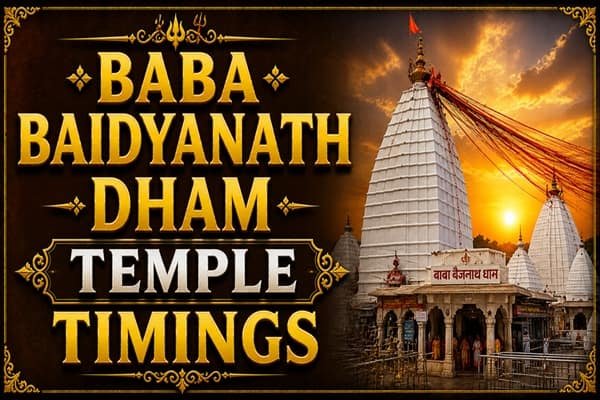
The Baba Baidyanath Dham Temple sits in Deoghar, Jharkhand, in the dry plains that rise towards the hills of Santhal Pargana. The temple is not on a riverbank like Varanasi. It is not in a cave like Amarnath. But the lingam here is one of the twelve Jyotirlingas. And next to it, in the same complex, is a Shakti Peetha. The heart of Sati fell here. The Lord is Baidyanath, the physician. The goddess is Parvati. The two are together. That is the uniqueness of this place. Not Shiva alone. Not Shakti alone. Both. The complex has twenty one temples. Devotees walk a parikrama. They visit each one. The lingam is black. The priests pour water. The queue moves slowly.
The temple is ancient. The lingam is believed to have been installed by Ravana. The story is well known. Ravana was a devotee of Shiva. He prayed for the lingam. Shiva gave it to him. But he was not allowed to place it on the ground until he reached Lanka. The gods, fearing his power, made him stop. The lingam fell. It stayed. The name Baidyanath comes from Vaidya, physician. Shiva is the healer. Devotees come with illnesses. They come with diseases that doctors cannot cure. They pour water. They tie threads. They hope.
Daily Darshan and Pooja Timings for 2026
The temple opens at 4:00 AM every day. The first ritual is Shodashopachar Puja at 4:00 AM. This is the morning offering. The priests chant. The lamps are lit. The morning darshan runs from 4:00 AM to 3:30 PM. Abhishekam is performed during the same window, from 4:30 AM to 3:30 PM.
The temple then closes for an afternoon break from 3:30 PM to 6:00 PM. During these two and a half hours, the sanctum remains closed. The priests perform internal rituals. Do not come during these hours expecting darshan.
The temple reopens at 6:00 PM. The Shringar Puja begins at 6:00 PM. The Lord is covered with sandal paste. The evening darshan runs from 6:00 PM to 9:00 PM. The temple closes at 9:00 PM.
Shravan Month Timings for 2026
Shravan is the busiest month. The temple sees lakhs of Kanwariyas, devotees carrying water from the Ganges. The timings change. On Mondays in Shravan, the temple stays open from 4:00 AM to 8:00 PM. The queue never ends. The crowd is massive. The energy is high. On other days of Shravan, Tuesday to Sunday, the temple is open from 4:00 AM to 6:00 PM.
If you plan to visit during Shravan, book your VIP pass in advance. Arrive early. The queue at 4:00 AM will already be long. Be prepared.
Rudrabhishek and Special Puja Charges for 2026
Rudrabhishek is the most important ritual. The cost with water is ₹251. The cost with milk is ₹356. Laghu Rudra Abhishek costs ₹356. Maha Rudra Abhishek costs ₹5,501. This is an elaborate ritual. It takes time. The priests chant the Rudram. The offerings are many. Atirudra costs ₹101. Mahamrityunjaya Jaap costs ₹551. This is for health, peace, and longevity.
All pujas must be booked in advance. Online booking is available through the official website. Visit the portal. Create an account. Select the puja you want. Choose your date and time slot. Enter the details of the devotee. Complete the payment. Download the confirmation. On the day of the puja, report at the designated counter.
Also Read : Guruvayur Temple Special Darshan Tickets 2026: Online Booking, Timings & Ticket Price
VIP Darshan Pass for 2026
General darshan is free. The wait on regular days is one to two hours. On Mondays and during Shravan, the wait can be four to six hours. The VIP Darshan Pass costs ₹500 for Indian devotees and ₹1000 for foreign devotees. The pass gives you priority entry through a separate queue. The wait reduces to thirty to sixty minutes.
VIP passes can be booked online. The process is the same as for pujas. Book early, especially during Shravan.
The Twenty One Temples
The complex is not one temple. It is twenty one temples. Devotees walk a parikrama. They visit each one. Maa Annapurna Temple, Maa Parvati Temple, Kal Bhairav Temple, Maa Kali Temple, Gauri Shankar Temple, Hanuman Temple, Ganesh Temple, Surya Narayan Temple, Maa Saraswati Temple. Each shrine is small. Each has its own deity. The parikrama takes about an hour. The stones are worn smooth. The feet of millions have carved the path.
Festivals Celebrated at the Temple
Shravan Mela is the biggest festival. It runs from July to August. The crowd is massive. The Kanwariyas pour water. The chants of Bol Bam fill the air. Shivratri Mela is in February or March. The temple stays open all night. The lingam is bathed every hour. The energy is intense. Shri Panchami Mela is in January. Bhadra Purnima is in September.
During all these festivals, the temple timings are extended. The crowds are heavy. The queues are long. Book your VIP pass well in advance.
How to Reach the Temple
By train, the nearest station is Baidyanath Dham Railway Station, about one kilometer from the temple. This is the most convenient option. Jasidih Junction is about eight kilometers away. From Jasidih, take a taxi or auto. The ride takes about fifteen minutes.
By road, the temple is connected to Sultanganj, about 53 kilometers away. Buses and taxis are available. By air, the nearest airports are Patna, about 260 kilometers away, and Kolkata, about 325 kilometers away. From the airport, take a taxi or train.
Accommodation Near the Temple
The temple trust runs a few guest houses. The rooms are simple. The prices are low. Private hotels near the temple range from budget to mid range. Prices start at ₹800 per night. During Shravan, book at least two weeks in advance. The town fills up. The rooms are scarce.
Best Time to Visit
The best time is October through March. The weather is pleasant. The summer heat is gone. The Shravan crowds are gone. The best days are weekdays, Tuesday through Thursday. Weekends are crowded. The best time of day is early morning, between 4:00 AM and 6:00 AM. The temple opens at 4:00 AM. The queue is short. The air is cool. The Shodashopachar Puja is fresh.
Avoid the summer months from April to June. The heat is intense. The queue is long. The darshan is exhausting.
A Final Word for First Time Visitors
The Baba Baidyanath Dham Temple is not a quiet temple. The queue is long. The sun is hot. The crowd is thick. But the lingam is not in the sanctum. It is in the water poured by strangers. It is in the chants of Bol Bam. It is in the step you take on stones worn smooth by millions of feet before you. The Lord is not in the stone. He is in the journey. Come early. Book your pass. Wait in the queue. The lingam is black. The water is cold. The priest will pour it on your hands. That moment is the blessing. Hold it.