
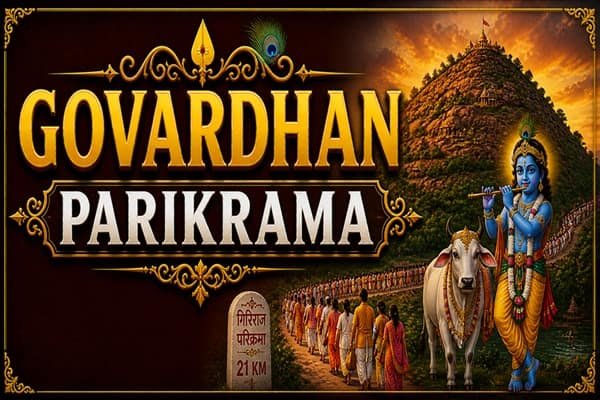
Govardhan Parikrama is not a walk. It is a conversation. The hill is not stone. It is Giriraj Maharaj, the form of Krishna who lifted a mountain on his little finger to protect his people. The path is not dirt. It is the ground that the Lord himself walked on. When you walk around Govardhan, you are not exercising. You are worshipping. Your feet are not carrying you. They are offering. Every step is a prayer. Every breath is a chant.
The parikrama is a circle. You start at Mansi Ganga. You walk clockwise. You keep the hill on your right. The distance is about twenty one kilometers. It takes five to six hours if you walk steadily. It takes longer if you stop at the temples and the kunds. You should stop. That is the point of the walk.
The Distance and the Time
The full parikrama is called Badi Parikrama. It is twenty one kilometers. The shorter route, Chhoti Parikrama, is nine kilometers. Most devotees walk the full route. The walk takes five to six hours. Elderly devotees may take eight hours. Those performing Dandavat Parikrama, lying flat on the ground and rising, take days or weeks. The distance is not the measure. The devotion is.
The walk is not flat. There are ups and downs. The path passes through villages, fields, and forest. The road is paved in many places. In others, it is dirt. In the rainy season, it is mud.
The Best Time to Walk
The best months are October through March. The weather is cool. The sun is gentle. The winter mornings are crisp. The best time of day is early morning, between 4:00 AM and 8:00 AM. The crowd is thin. The air is fresh. The chants are soft.
In the summer months, from April to June, the heat is intense. The path is hot. The dust rises. Many devotees choose to walk at night, from 9:00 PM to 4:00 AM. The moon lights the path. The air is cooler. But the night walk is not for the faint hearted. The path is dark in places. You need a group.
The Kartik month, October to November, is the most auspicious time. The parikrama is crowded. The energy is high. The temples are decorated. The kunds are lit with lamps. If you want to feel the devotion at its peak, come in Kartik.
Also Read : Chaitra Navratri 2026: Dates, Ghatasthapana Timings, Nine Forms of Durga & Rituals
The Starting Point and the Route
The traditional starting point is Mansi Ganga. This is a sacred pond. The story says that Ganga appeared here by Krishna’s will. Devotees bathe here before starting the parikrama. The water is cold. The steps are old. The ritual is cleansing.
From Mansi Ganga, you walk to Daan Ghati Mandir. This is the main temple of Giriraj Maharaj. The idol is black stone. The expression is calm. The temple is small. The queue is long.
You then walk to Mukharvind. This is the face of the hill. There is a crack in the rock. Devotees believe it is the mouth of Giriraj Maharaj. You offer milk, water, and tulsi. The priests pour the offerings into the crack. The rock drinks. The faith is real.
The route passes through the village of Jatipura. The temple here is famous for the Chhappan Bhog, the fifty six offerings. The bhog is prepared every day. The aroma fills the air. You can buy prasad here.
You then walk to Kusum Sarovar. This is a large pond with stone steps. The water is green. The trees are old. This is where Radha collected flowers for Krishna. The atmosphere is peaceful. You can sit here. Rest. The parikrama is not a race.
From Kusum Sarovar, you walk to Radha Kund and Shyam Kund. These are the holiest kunds in Braj. Radha Kund is the pond where Radha bathed. Shyam Kund is where Krishna bathed. The water is considered sacred. Devotees take a dip. The water is cold. The belief is strong.
You then walk to Kaan Wale Baba. This is a small temple. There is a stone ear. Devotees whisper their wishes into the ear. They believe that Giriraj Maharaj hears them directly. The stone is worn smooth by the lips of millions.
The route passes through Poonchhri Ka Lautha. This is the residence of Krishna’s friend, Poonchhri. The parikrama is considered incomplete without visiting this spot. The temple is small. The crowd is large.
You then return to Mansi Ganga. The circle is complete. The walk is done.
The Rituals
Most devotees walk barefoot. The ground is rough in places. The stones are sharp. The blisters are part of the offering. If you cannot walk barefoot, wear soft shoes. But the tradition is barefoot.
Chant the name of Krishna. Radhe Radhe. Jai Giriraj Maharaj. Hare Krishna Hare Krishna. The chant keeps the mind focused. The feet move. The mouth moves. The mind becomes still.
Bathe at Mansi Ganga before starting. The water is cold. The purification is symbolic. But the devotion is not symbolic.
Offer milk, water, and tulsi at Mukharvind. The priests will guide you. The offering is small. The blessing is large.
If you have a wish, whisper it at Kaan Wale Baba. The stone ear is listening. The Lord is not deaf.
Do not leave the parikrama incomplete. If you start, finish. The circle is sacred.
The Dandavat Parikrama
Some devotees perform Dandavat Parikrama. They lie flat on the ground. They mark the spot with their hands. They rise. They lie down again. They repeat this for the full twenty one kilometers. The walk takes days. The body aches. The dust covers the skin. The devotion is absolute. They are not walking. They are measuring the earth with their bodies. They are becoming the dust. That is the surrender.
Facilities on the Route
There are drinking water points along the path. The water is not always clean. Carry your own bottle. There are food stalls. The food is simple, samosas, chai, biscuits. Eat light. Do not overload the stomach.
Rest areas are available. Sit. Breathe. The walk is long. There are dharamshalas near the starting point. If you plan to stay overnight, book in advance. During Kartik month, the rooms are full.
A Final Word for First Time Walkers
The Govardhan Parikrama is not a trek. Do not treat it as a physical challenge. The distance is not the goal. The time is not the measure. The goal is to feel the presence of Krishna in the stone, in the dust, in the water of the kunds. The hill is not a landmark. It is a deity. Walk slowly. Chant softly. Stop at the temples. Sit at the kunds. Touch the stone. The hill has been here for thousands of years. It will not move. You can move slowly. That is the teaching. Not speed. Surrender.