
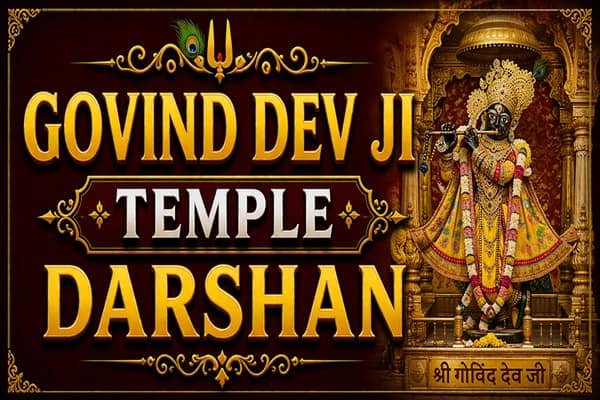
The Govind Dev Ji Temple sits inside the City Palace complex in Jaipur, not in a crowded lane like the older temples of the old city. The palace walls surround it. The gardens are neat. The red sandstone glows in the morning light. The temple is not ancient by Indian standards. It was built in 1735 by Raja Sawai Jai Singh II, the founder of Jaipur. The idol was brought from Vrindavan, where it had been installed in 1590. The original temple in Vrindavan was partially destroyed by Mughal forces in 1670. The idol was moved to save it. It was moved again. Finally, it was brought to Jaipur. The king built a temple for it inside his palace. The Lord became the king’s personal deity. The tradition continues. The royal family still participates in the rituals.
The deity is Govind Dev Ji, a form of Krishna. The idol is black stone. The eyes are large. The expression is calm. The temple is one of the seven sacred temples of the Thakur of Vrindavan. Devotees believe that the idol perfectly reflects the divine form of Krishna as he appeared on Earth. The temple is not large. The crowd is. On Janmashtami, the queue stretches through the palace courtyards. On Holi, the colors fly. The temple is a place of royal devotion. But the devotion is not royal. It is personal.
Daily Darshan Timings for 2026
The timings change with the season. In summer, from April to September, the morning darshan runs from 4:30 AM to 12:00 PM. The evening darshan runs from 5:45 PM to 9:30 PM. The temple closes for a break from 12:00 PM to 5:45 PM.
In winter, from October to March, the morning darshan runs from 5:00 AM to 12:15 PM. The evening darshan runs from 5:00 PM to 8:45 PM. The break is from 12:15 PM to 5:00 PM.
The early morning hours are the best. In summer, 4:30 AM. In winter, 5:00 AM. The crowd is light. The palace is quiet. The Mangla Aarti at 5:00 AM starts the day.
Aarti Schedule for 2026
The temple conducts seven aartis every day. Mangla Aarti is from 5:00 AM to 5:15 AM. This is the first aarti. The deity is awakened. The lamps are lit. The chants are soft.
Dhoop Aarti is from 7:45 AM to 9:00 AM. Incense is offered. The sanctum fills with smoke. The morning light streams through the windows.
Shringar Aarti is from 9:30 AM to 10:15 AM. The deity is dressed and decorated. The idol looks beautiful. The ornaments shine.
Rajbhog Aarti is from 10:45 AM to 11:15 AM. The midday meal is offered. The aroma of the food fills the air.
Gwal Aarti is from 5:00 PM to 5:15 PM. The evening begins. The lamps are lit again.
Sandhya Aarti is from 5:45 PM to 6:45 PM. This is the main evening aarti. The temple is crowded. The bells ring. The lamps are waved.
Shayan Aarti is from 8:00 PM to 8:15 PM. The final aarti. The deity is prepared for rest. The chants become soft. The sanctum darkens.
Also Read : Khodiyar Mandir Rajpara Timings 2026: Darshan, Aarti & Travel Guide
Festivals Celebrated at the Temple
Janmashtami is the biggest festival. The temple is packed. The midnight aarti marks the birth of Krishna. The queue forms by 8:00 PM. The crowd is thick. The energy is high. The temple stays open all night.
Holi is celebrated with colors. The temple premises are filled with devotees throwing gulal. The idols are smeared with color. The atmosphere is joyful.
Diwali is celebrated with lamps. The temple is decorated with lights. The evening aarti is special. The reflection of the lamps on the marble floors is beautiful.
How to Reach the Temple
By train, the nearest station is Jaipur Railway Station, about 5.5 kilometers from the temple. From the station, take a taxi or auto. The ride takes about fifteen to twenty minutes.
By air, the nearest airport is Jaipur International Airport, about 12 kilometers from the temple. From the airport, take a taxi. The drive takes about thirty minutes.
By road, the temple is inside the City Palace complex. Auto rickshaws and taxis are available from anywhere in the city. The temple is well known. Any driver will know it.
Nearby Attractions
City Palace is not a separate attraction. The temple is inside it. The palace museum is next to the temple. The courtyards are open. The architecture is stunning. Jantar Mantar, the astronomical observatory, is 500 meters away. It is a UNESCO site. Hawa Mahal, the Palace of Winds, is one kilometer away. The facade is iconic. Jal Mahal, the water palace, is four kilometers away. The palace sits in the middle of a lake. Amer Fort is 11 kilometers away. The fort is majestic. The view from the hill is worth the climb.
Accommodation Near the Temple
Panchayati Dharamshala is a budget option. The rooms are simple. The prices are low. ISKCON Guest House is another option. The atmosphere is peaceful. Janupyogi Bhawan is comfortable. Hotel Lords Plaza is a mid range hotel. Hotel Thikana Palace is a luxury option.
During Janmashtami, book at least two weeks in advance. The city fills up. The hotels are full.
Best Time to Visit
The best months are October through March. The weather in Jaipur is pleasant. The summer heat is gone. The winter mornings are cool. The best days are weekdays, Tuesday through Thursday. Weekends are crowded. The best time of day is early morning. The Mangla Aarti at 5:00 AM is the most peaceful.
A Final Word for First Time Visitors
The Govind Dev Ji Temple is in a palace. The walls are thick. The courtyards are wide. The deity is not in a crowded lane. He is in a royal garden. But the devotion is not royal. It is ordinary. That is the miracle. The king built the temple. The king installed the idol. But the king does not own the Lord. The devotee does. The devotee who comes at 4:30 AM in the summer, when the city is still dark, who climbs the steps, who stands in the queue, who looks at the black stone face, that devotee owns the Lord. The king is gone. The devotee remains. That is the lesson of Govind Dev Ji. Come early. Come quiet. Come alone. The Lord is waiting.