
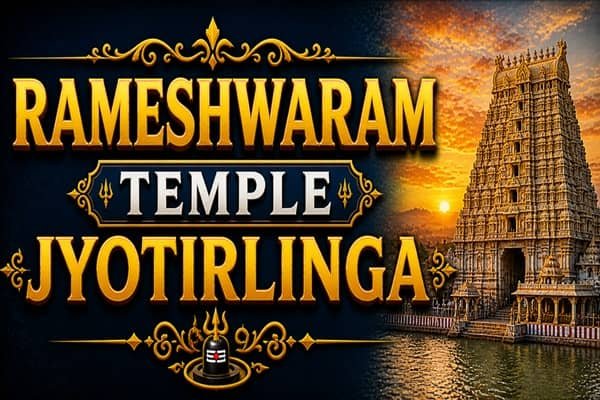
The Rameshwaram Temple sits on Pamban Island, at the southern tip of India, where the Bay of Bengal meets the Indian Ocean. The sea is everywhere. You smell it before you see the temple. The sound of waves mixes with the sound of bells. The temple is dedicated to Lord Shiva, but the story here is about Rama. After defeating Ravana, Rama needed to cleanse himself of the sin of killing a Brahmin. He built a lingam out of sand and worshipped Shiva. That sand lingam is still here. It is the Jyotirlinga. The temple is one of the twelve, and also one of the four Char Dhams. To the north is Badrinath, to the west Dwarka, to the east Puri, and to the south Rameshwaram. The four corners of India. Pilgrims who visit all four are considered to have completed the circle of the nation.
The temple is not just a building. It is a complex. The corridors are long, the longest in the world. The pillars are numbered. The ceilings are painted. The theerthams, twenty two of them, are inside the temple. Each well has water that tastes different. Each is believed to have healing properties. Devotees bathe in all twenty two before entering the sanctum. The water is cold. The ritual is long. The belief is old.
Daily Darshan Timings for 2026
The temple opens at 5:00 AM every day. The morning darshan runs from 5:00 AM to 1:00 PM. The early morning hours, between 5:00 AM and 8:00 AM, are the best. The crowd is light. The sun is not yet harsh.
The temple then closes for an afternoon break from 1:00 PM to 3:00 PM. During these two hours, the sanctum remains closed. The priests perform internal rituals. Do not come during these hours expecting darshan.
The evening darshan runs from 3:00 PM to 9:00 PM. The evening aarti is at 6:00 PM. The temple closes at 9:00 PM.
The temple is open on all days of the week. The schedule does not change for weekends. The crowd does. Weekends are crowded. Avoid them if you can.
Dhanushkodi Visiting Timings
Dhanushkodi is about twenty kilometers from Rameshwaram. This is the place where Rama built the bridge to Lanka. Today, it is a ghost town. A cyclone in 1964 destroyed the railway station, the church, the houses. The ruins remain. The sea has reclaimed much of the land. The road ends at the water. Beyond is only sand and waves.
Dhanushkodi is open from 6:00 AM to 6:00 PM every day. The best time to visit is early morning or late afternoon. The sun is less harsh. The light is golden. The silence is heavy.
There is no temple at Dhanushkodi. There is only the sea and the sand and the memory of Rama. Devotees come here to meditate, to offer prayers, to feel the presence of the Lord who built a bridge with stones that floated on water.
The Twenty Two Theerthams
Inside the temple complex, there are twenty two sacred wells. They are not pools. They are deep wells with stone steps leading down to the water. Devotees take a bath in each one. The ritual is called Theerthavari. You start at Agni Theertham, the well near the sea, outside the temple. Then you enter the temple and bathe in the remaining twenty one. Each well has a name. Each water tastes different. Some are salty. Some are sweet. Some are cold. Some are warm. The priests say the water comes from different underground springs. The devotees say the water comes from different gods.
The theerthams are open during temple hours. There is no separate fee. You need a towel and a change of clothes. The water is cold even in summer. Be prepared.
History of the Temple
The temple was built in the 12th century by the Pandya kings. Later, the rulers of the Vijayanagara Empire expanded it. The corridor with the thousand pillars was added in the 17th century. The current structure is over 1,200 feet long. The pillars are carved with figures of gods, goddesses, and warriors. The ceiling is painted with scenes from the Ramayana.
The main deity is Ramanathaswamy, the lingam made by Sita from sand. Next to it is Vishwalingam, the lingam brought by Hanuman from Mount Kailash. Lord Rama instructed that Vishwalingam be worshipped first. That tradition continues. Devotees pray to Vishwalingam, then to Ramanathaswamy.
Architecture
The corridors of the Rameshwaram Temple are the longest in the world. The outer corridor is 1,220 meters long. The inner corridor has 1,212 pillars. The pillars are made of granite. Each one is carved. No two are the same. The effect is overwhelming. Walking through the corridor, you feel small. The stone is dark. The light is dim. The pillars stretch into the distance, row after row, like a forest made of rock.
The Rajagopuram, the main tower, is 53 meters high. You can see it from the road. You can see it from the sea. It is the landmark of the island.
The Nandi statue is 17.5 feet tall. It sits facing the sanctum. The carving is smooth. The expression is calm.
Also Read : Omkareshwar Jyotirlinga Darshan 2026: VIP Tickets, Timings & Abhishekam Booking
How to Reach the Temple
By air, the nearest airport is Madurai, about 180 kilometers from Rameshwaram. Madurai is connected to major cities. From the airport, take a taxi. The drive takes about three hours.
By train, Rameshwaram Railway Station is about one kilometer from the temple. The station is connected to Chennai, Madurai, and Coimbatore. From the station, take an auto. The ride takes five minutes.
By road, Rameshwaram is connected to Chennai by National Highway 49. The drive takes about nine hours. Buses run from Chennai, Madurai, and Coimbatore. The bus station is two kilometers from the temple.
Best Time to Visit
The best months are October through March. The weather is pleasant. The sea breeze is cool. The summer months from April to June are hot. The monsoon months from July to September bring heavy rain. The sea is rough. The roads can be flooded.
The best days are weekdays, Tuesday through Thursday. Weekends are crowded. Monday is also crowded.
Entry Fee and Camera Charges
There is no entry fee for darshan. The temple is free. Still cameras are allowed in the outer areas for a fee of ₹25. Photography is not allowed inside the sanctum. Mobile phones are allowed, but photography is restricted.
A Final Word for First Time Visitors
Rameshwaram is not a quiet temple. The waves crash. The buses honk. The priests call out. The devotees push. But the lingam is not in the sanctum. It is in the water of the twenty two wells. It is in the sand of Dhanushkodi. It is in the pillar that looks like the one before it and the one after it. The temple is too large to see in one visit. The corridors are too long to walk in one day. That is the teaching. Not completion. Continuation. You come. You bathe. You pray. You leave. The temple stays. The sea stays. The Lord stays. Come back when you can. He will not move.