
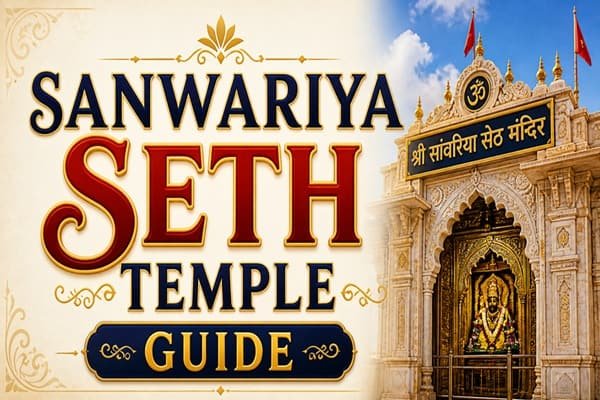
The Sanwariya Seth Temple in Mandaphia village, Rajasthan, is not like other Krishna temples. Here, the Lord is not just worshipped. He is treated as a business partner. Devotees come with their account books. They pray for profit. When their wishes come true, they return and offer a share of their income at the temple. This tradition is not new. It has been happening for nearly two centuries. The deity is a black stone idol of Lord Krishna, discovered in 1840 by a milkman named Bholaram Gujar. He had a dream. He saw three idols buried underground. The villagers dug. They found three black stone idols exactly where the dream had shown. One was installed at Mandaphia. This became the Sanwariya Seth Temple. The other two went to Bhadsora and Chapar.
The name Sanwariya comes from the dark complexion of Krishna. Seth means businessman. The devotees gave him this name because they experienced his help in their businesses. He became the Seth of Seths, the God of the trading community. Today, the temple is one of the richest in Rajasthan. The donation boxes are opened monthly. During festivals, the collections cross seventeen crores. That is the faith of the people who believe that Sanwariya Seth listens.
Daily Darshan Timings for 2026
The temple opens at 5:30 AM every day. The first ritual is Mangala Aarti at 5:30 AM. The doors open. The lamps are lit. The priests chant. The morning darshan runs from 5:30 AM to 12:00 PM. The early morning hours are the best. The crowd is light. The air is cool. The energy is fresh.
The temple then closes for a break from 12:00 PM to 2:30 PM. During these two and a half hours, the sanctum remains closed. The Lord rests. The priests perform internal rituals. Do not come during these hours expecting darshan.
The temple reopens at 2:30 PM. The evening darshan runs from 2:30 PM to 11:00 PM. Yes, the temple stays open late. This is unusual for temples in Rajasthan, but Sanwariya Seth stays awake for his devotees. The evening aarti happens around 6:30 PM. The Rajbhog Aarti is at 9:00 AM in the morning. From 8:00 PM to 9:15 PM, special pooja is performed. From 9:15 PM to 11:00 PM, bhajan and kirtan sessions are held. The final Shayan Aarti, the bedtime ritual, happens between 9:30 PM and 10:30 PM. The temple closes at 11:00 PM.
On Ekadashi, Janmashtami, and other major festivals, the timings may change. The temple may stay open later. The crowds become massive.
Aarti Schedule You Should Not Miss
Mangala Aarti at 5:30 AM is the first aarti of the day. The temple is quiet. The lamps are lit. The priests chant softly. Attending this aarti is a peaceful way to start your day.
Shringar Aarti happens around 9:00 AM. The timing varies slightly. The deity is dressed and decorated. The idol looks beautiful. Rajbhog Aarti is between 10:00 AM and 11:15 AM. This is the most important aarti for businessmen. They believe that prayers offered during Rajbhog Aarti bring prosperity and success.
Evening Aarti is around 6:30 PM. The temple fills up. The lamps are waved. The chants become louder. Shayan Aarti, the bedtime aarti, happens between 9:30 PM and 10:30 PM. The deity is prepared for rest. The chanting becomes soft. Many devotees end their visit with this aarti.
From 9:15 PM to 11:00 PM, the temple holds bhajan and kirtan sessions. Devotees sit on the floor. The singers sing. The audience joins. The sound of the harmonium and the drums fills the air. The energy is devotional but calm.
The Business Partner Tradition
This is the most unique aspect of Sanwariya Seth Temple. Businessmen treat the Lord as a silent partner. They pray for success. They promise a share of the profit. When the profit comes, they return and offer a percentage at the temple. Some do this monthly. Others do it annually. The temple does not ask for it. The devotees bring it themselves.
The donation boxes are opened once a month. The counting is done publicly. The amounts are huge. During the monthly fair, donations cross seventeen to nineteen crores. The temple trust uses this money for maintenance, for running guest houses, for feeding pilgrims, and for charitable activities.
This tradition has made the temple famous. The Lord is not a distant deity. He is a partner. He is involved. He cares. That is why the trading community of Rajasthan, Gujarat, and Madhya Pradesh flocks to this temple. They come with account books and receipts. They come with gratitude.
The Legend of the Three Idols
The story begins in 1840. Bholaram Gujar was a milkman. One night, he dreamt of three idols of Lord Krishna buried underground in Chapar village. The dream was vivid. The location was specific. He told the villagers. They dug. They found three black stone idols exactly where the dream had shown.
One idol was installed at Mandaphia. This became the main Sanwariya Seth Temple. The second idol was installed at Bhadsora. The third remained at Chapar, the original discovery site. All three sites are now pilgrimage spots.
The Mandaphia temple was initially a small shrine built by Rodulal Jain, the village head. Over the years, it grew. The small shrine became a four walled structure. The four walled structure became a complex. Today, it is a magnificent temple with white marble, intricate carvings, and spacious courtyards.
Also Read : Ayodhya Ram Mandir Free Sugam Darshan E Pass 2026: Online Booking & Timings
Temple Architecture
The architecture follows traditional Rajasthani design. The shikhara, the tower, is visible from a distance. The pillars are intricately carved. The ceilings are painted. The sanctum houses the black stone idol of Lord Krishna. The idol is decorated with clothes, jewels, and flowers. The decoration changes throughout the day. In the morning, the idol is simple. By the afternoon, it is adorned. By the evening, it is grand.
The temple complex includes a spacious mandapa, a pillared hall where devotees sit and sing bhajans. There are prasadam distribution counters, administrative offices, and guest facilities. Shops sell religious items, sweets, and offerings.
The white marble and stone give the complex a pristine, divine appearance. When the evening lights are turned on, the temple glows.
Festivals Celebrated at the Temple
Janmashtami is the biggest festival. The temple is packed. The decorations are elaborate. Special midnight darshan is held. The celebrations go on all night. If you want to experience the temple at its most vibrant, come on Janmashtami. But be prepared for massive crowds.
Jaljhulani Ekadashi is a three day grand fair. It is held on Dashami, Ekadashi, and Dwadashi of Bhadrapada Shukla Paksha. The idols are placed on swings. Devotees sing and dance. The festival has been celebrated since 1961.
Holi is celebrated with colors and devotional music. Diwali and Annakut are also grand. After Diwali, a mountain of food, the Annakut, is offered to the deity. This symbolizes Govardhan Puja. Radhashtami, the appearance day of Radha, is observed with special prayers. Kartik Purnima brings holy bathing rituals and special poojas.
During all these festivals, the temple timings are extended. The crowds become massive. Book your accommodation well in advance.
How to Reach the Temple
By road, the temple is on National Highway 27, about forty kilometers from Chittorgarh. From Chittorgarh, take the highway towards Udaipur. The drive takes about forty five minutes. Buses run regularly. Taxis are available. From Udaipur, the temple is about eighty kilometers. The drive takes about one and a half hours. From Jaipur, the temple is about 330 kilometers. The drive takes about six hours.
By train, the nearest railway station is Chittorgarh Junction, about thirty five kilometers from the temple. Chittorgarh is connected to major cities like Delhi, Jaipur, Mumbai, Ahmedabad, and Kolkata. From the station, take a taxi or bus. The ride takes about forty five minutes.
By air, the nearest airport is Maharana Pratap Airport in Udaipur, about one hundred kilometers from the temple. Daily flights connect Udaipur to Delhi, Mumbai, Chennai, Hyderabad, and Bangalore. From the airport, hire a taxi. The drive takes about two hours.
Accommodation Near the Temple
The temple trust runs guest houses. Shri Sanwaliya Dham Guest House in Bhadsora has AC rooms, parking, CCTV, and hot water. The rates are subsidized for pilgrims. Shri Sanwaliya Dham AC Guest House is located near the temple. It has 47 rooms and 4 suites. There is a banquet hall. Booking is available online.
Budget dharamshalas near the temple offer basic rooms at low rates. They have community dining and simple facilities. For more comfortable stays, hotels in Chittorgarh are a good option. Kukda Resort, Hotel Sai Kripa, and other mid range hotels offer better amenities. The drive from Chittorgarh to the temple takes about forty five minutes.
During festivals, book your accommodation at least two weeks in advance.
A Final Word for First Time Visitors
The Sanwariya Seth Temple is not a quiet, forest retreat. It is a busy, prosperous temple in the heart of Rajasthan. The devotees are businessmen. The offerings are large. The deity is treated as a partner. Do not come here expecting solitude. Come here expecting faith. The faith of the trading community is palpable. It is in the way they open their account books in front of the idol. In the way they calculate their offerings. In the way they thank the Lord for his partnership. That faith is the real wealth of this temple. Not the seventeen crores in the donation box. Not the white marble. Not the carved pillars. The faith. Stand in the queue. Watch the devotees. You will understand.