
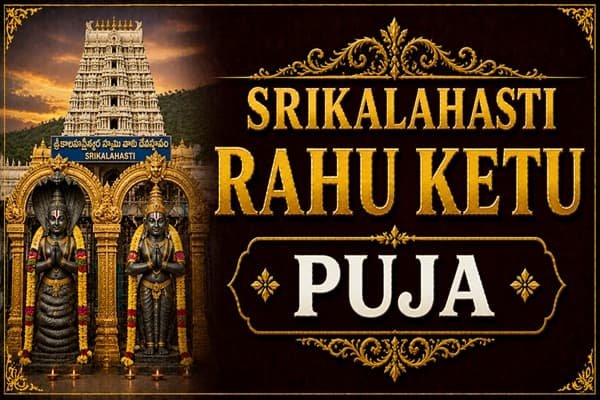
The Sri Kalahasti Temple sits in the town of Sri Kalahasti in Andhra Pradesh, about forty kilometers from Tirupati. This temple is not like other Shiva temples. It is one of the five Pancha Bhoota Sthalas, representing the element of air or Vayu. The main deity, Sri Kalahasteeswara, is worshipped as a Vayu Linga. But the temple gained its greatest fame for a different reason. It is the most powerful place in India to perform the Rahu Ketu Pooja. Thousands of devotees come here every year, seeking relief from the shadow planets that cause obstacles in marriage, career, health, and peace of mind.
Rahu and Ketu are not physical planets. They are shadow planets, the points where the moon’s orbit intersects the sun’s path. In Vedic astrology, they are considered karmic forces. When placed in certain houses of the horoscope, they create doshas or imbalances. These doshas can delay marriage, cause financial problems, create health issues, or bring repeated failures. The Rahu Ketu Pooja at Sri Kalahasti is believed to reduce these negative effects and bring peace.
Why Sri Kalahasti is Unique for Rahu Ketu Pooja
Many temples perform Rahu Ketu Pooja. But Sri Kalahasti is different. According to legend, Lord Shiva himself granted liberation to Rahu and Ketu at this very place. The story goes that Rahu and Ketu, after being separated from the body of the demon Svarbhanu, sought refuge in Lord Shiva. He accepted them and blessed them. This act symbolizes the removal of darkness and confusion. When you perform the pooja here, you are tapping into that original energy of liberation.
The temple also remains open during solar and lunar eclipses. Most temples close during eclipses. Sri Kalahasti stays open. In fact, performing the pooja during an eclipse is considered even more powerful. The temple sees huge crowds on Amavasya, or new moon days, and during Rahu Kalam, the inauspicious period of the day associated with Rahu.
Another unique feature is the Vayu Linga. The air element represents the breath of life. The pooja involves offering milk, flowers, and camphor to this Linga while priests chant specific mantras. The combination of the powerful deity and the specific mantras makes this pooja particularly effective for Rahu and Ketu doshas.
Ticket Types and Prices for 2026
The temple offers five categories of tickets for the Rahu Ketu Pooja. Each category has a different seating location and price. The pooja lasts between thirty and forty five minutes regardless of the ticket type.
General Ticket costs ₹500. The seating is in the open mandap. You get basic pooja materials and the priest’s service. This is the most affordable option. The waiting time can be longer because many devotees choose this category.
Special Ticket costs ₹750. The seating is in the South Hall, closer to the main shrine. You also get a dedicated priest for your pooja. The queue moves faster than the general category.
VIP Ticket costs ₹1,500. The seating is in the North Hall. You receive a personalized pooja experience and sit very close to the main shrine. The waiting time is minimal.
Premium Ticket costs ₹2,500. The seating is in an air conditioned hall. This ticket includes family seating and an audio guide that explains the ritual. Ideal for elderly devotees or families with children.
Eka Varam Pooja costs ₹5,000. This is the most elaborate option. The seating is in the main mandap. The ritual is longer and more detailed. It is specifically designed for extended Rahu Ketu Dosha Nivarana.
Children below twelve years are not allowed to sit for the pooja. They can wait outside with a family member.
Daily Timings and Best Days to Perform
The pooja is conducted from 6:00 AM to 6:00 PM every day. Slots are available every one and a half hours. The morning slots are 6:00 AM, 7:30 AM, 9:00 AM, 10:30 AM, and 12:00 PM. The afternoon slots are 1:30 PM, 3:00 PM, 4:30 PM, and 6:00 PM.
The best days to perform the pooja are Rahu Kalam, Sundays, Tuesdays, and Amavasya. Rahu Kalam is a specific period each day that lasts about an hour and a half. The timing changes based on sunrise and sunset. Checking the day’s Rahu Kalam before booking your slot is recommended. Sundays and Tuesdays are considered auspicious for Rahu and Ketu worship. Amavasya, the new moon day, is the most powerful. On Amavasya, the temple sees the heaviest crowds. Tickets for these days sell out weeks in advance.
During solar and lunar eclipses, the temple remains open and conducts the pooja. The crowd becomes massive. Book at least one month in advance if you plan to visit during an eclipse.
Step by Step Online Booking Process
Booking online is the easiest and most reliable method. The official portal is simple to use. Start by visiting the website. Look for the Book Rahu Ketu Pooja option on the homepage. Click it.
Select your preferred date. The calendar shows available dates. Choose your ticket type from the five categories. Enter the number of persons in your group. Each person needs a separate ticket. Children under twelve are not allowed, so only count adults.
Enter the personal details for each devotee. Full name, age, and mobile number are required. The system also asks for ID proof type and number. Aadhaar card works best.
Complete the payment using UPI, credit card, debit card, or net banking. After successful payment, you receive a confirmation email and a QR code. Download this QR code. Take a printout and also save a PDF on your phone.
On the day of the pooja, arrive at the temple at least one hour before your slot. Go to the counter designated for online bookings. Show your QR code. The staff gives you the pooja kit, which includes silver idols of Rahu and Ketu, flowers, camphor, and instructions. Then you are directed to your assigned seating area.
If you cannot book online, offline tickets are available at the temple counter. But the number is limited. On busy days like Amavasya, offline tickets sell out within an hour of the counter opening. Online booking is strongly recommended.
The Pooja Procedure What Happens During the Ritual
Arrive early. Reach the temple one hour before your slot. This gives you time to wash your hands and feet at the water tap near the Rahu Ketu mandap, collect your pooja kit, and find your seat.
The priest begins by chanting the Rahu Ketu Dhyana Mantras. These are specific mantras dedicated to the shadow planets. You are expected to sit facing north. The priest chants, and you repeat after him. Do not worry about pronunciation. The priest guides you.
After the chanting, you offer milk, flowers, and betel leaves to the Vayu Linga. The priest performs the main ritual while you observe. Camphor is lit and waved before the linga. The flame is passed to you. You cup your hands over the flame and bring the warmth to your eyes. This is the aarti.
The priest then hands you the silver idols of Rahu and Ketu. You are supposed to take these idols home and keep them in your pooja room. They become objects of daily worship. Do not throw them away.
The entire pooja lasts between thirty and forty five minutes. After completion, you can take darshan of Lord Shiva and Goddess Gnana Prasunambika Devi. The temple advises that you avoid visiting other temples for the rest of the day.
Dress Code and Rules to Follow
The temple enforces a strict dress code for the Rahu Ketu Pooja. Men must wear dhoti or pyjama with a shirt. Kurtas are also acceptable. Shirts and trousers are allowed but traditional attire is preferred. Shorts and jeans are not permitted.
Women must wear saree or salwar kameez. Western outfits like skirts, jeans, and sleeveless tops are not allowed. Black clothing is strictly prohibited for both men and women. This is very important. Do not wear black.
Footwear must be removed before entering the temple premises. Shoe stands are available near the entrance. Leather items like belts and wallets are best left in your car or hotel.
Do not eat non vegetarian food or drink alcohol on the day of the pooja. The temple expects a pure, clean body and mind. Maintain silence during the ritual. Loud conversations disturb other devotees and break the meditative atmosphere.
Women are allowed to perform the pooja, except during menstruation days. The temple advises waiting until the cycle is complete before booking.
Also Read : Mopidevi Temple Online Booking: Darshan Timings, Pooja Tickets & Seegra Darshan 2026
How to Reach Sri Kalahasti Temple
By air, the nearest airport is Tirupati International Airport, about forty kilometers away. Tirupati connects to major cities like Chennai, Hyderabad, Bangalore, and Delhi. From the airport, hire a taxi. The drive takes about one hour.
By train, Sri Kalahasti has its own railway station. Trains from Tirupati, Chennai, and Bangalore stop here. The station is about three kilometers from the temple. Auto rickshaws are available. The ride takes ten minutes.
By road, Sri Kalahasti is on National Highway 71. Regular buses from Tirupati, Chennai, and Bengaluru stop at the town. Private taxis are also available. The drive from Tirupati takes about one hour.
Local transport includes auto rickshaws and shared jeeps. From the bus stand or railway station, an auto to the temple costs about ₹50 to ₹80.
Accommodation Near the Temple
Sri Kalahasti has several budget and mid range hotels. The temple trust also runs a few choultries with basic rooms. Prices range from ₹500 to ₹2,000 per night. Most hotels are within walking distance of the temple.
For more comfortable stays, consider staying in Tirupati. Tirupati has many hotels in the ₹2,000 to ₹5,000 range. The drive from Tirupati to Sri Kalahasti takes about one hour. This option works well for families who prefer more amenities.
During Amavasya and other peak days, book your accommodation at least two weeks in advance. The town fills up with devotees. Rooms become scarce.
A Final Word for First Time Devotees
The Rahu Ketu Pooja at Sri Kalahasti is not a magic solution. It is a ritual that helps you align yourself with cosmic forces. The mantras, the offerings, the Vayu Linga, all of it works together to create a shift in your energy. But you must come with faith. Perform the pooja, keep the silver idols in your home, and then live your life with awareness. The dosha does not vanish overnight. It loosens its grip gradually. And one day, you look back and realize the problems that seemed impossible have found solutions. That is the grace of Sri Kalahasteeswara.